Warrior Shaft R, F or C — Which One Should You Pick?
Choosing between R, F and C Warrior based on your playing style, discipline and existing cue — plus what to watch for when ordering.
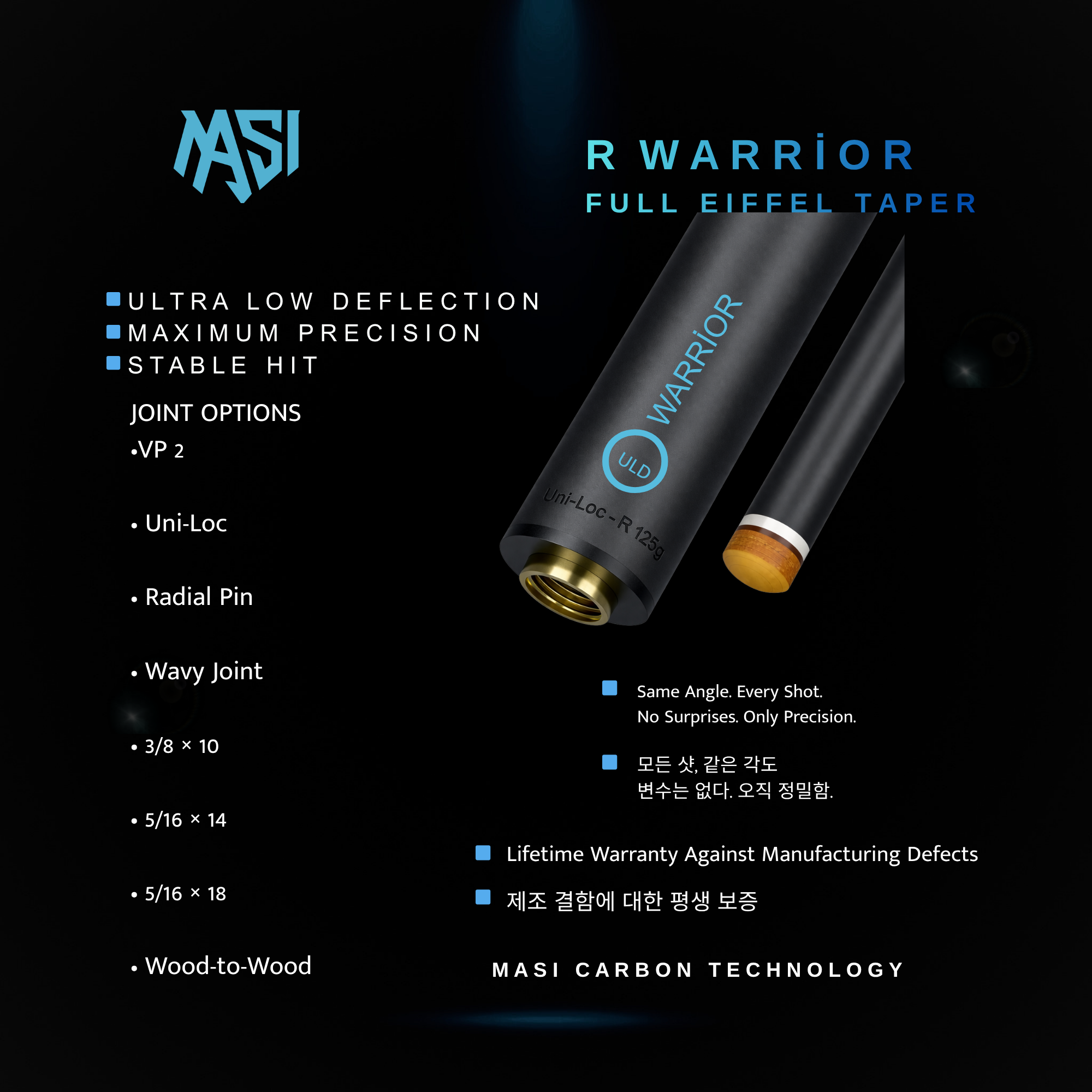
"Which Warrior shaft should I buy?" is the question we get most. The technical differences are covered in the shaft technology article; this one is about the decision itself: which player should pick which model?
What is identical across all three
- Carbon fiber body
- Tip diameter 11.9 – 12.2 mm
- Standard tip: Gorina M (changeable on request)
- Compatible with every joint type
- Lifetime warranty against manufacturing defects
So you cannot narrow the choice by diameter, tip or joint — those are the same. Two variables remain: taper profile and weight.
Decision table
- R Warrior — full Eiffel taper, 105 – 160 g. Firm, crisp, repeatable. For aggressive tempo, powerful strokes and players who want more mass on the shaft side.
- F Warrior — half Eiffel taper, 105 – 160 g. Softer transitions, graduated feedback. For touch and position play.
- C Warrior — conical taper, 105 – 160 g. Direct power transfer, sharp control. For players moving over from a wooden conical shaft.
By playing style
Hard hitter, fast tempo: R Warrior. The clear feedback of the full Eiffel taper makes it easier to read what happened on a powerful stroke, and R is the only model that goes beyond 130 g if you want shaft-side mass.
Touch player, position-focused: F Warrior. The gentler transition of the half Eiffel taper makes control easier at low stroke speeds.
Long-time wooden conical shaft user: C Warrior. It disturbs your existing habits least during the switch — you get carbon's consistency in a familiar geometry.
By discipline
- Three-cushion carom: long-distance strokes with heavy spin dominate, so players tend toward the clearer feedback of R or the familiar conical feel of C. Discipline-specific sizing is in our three-cushion guide.
- Pool: as position play carries more weight, touch sensitivity comes forward and F is often preferred.
These are tendencies, not rules. Plenty of players in the same discipline use completely different profiles — your stroke tempo is what decides.
Weight: the variable most people miss
Shaft weight changes the balance of the whole cue. Adding mass to the shaft moves the balance point forward and the cue feels heavier and more self-propelling; a lighter shaft moves balance rearward and the cue feels more agile.
That is why R Warrior's 105 – 160 g range matters: it gives adjustment room to players who want a forward balance. F and C sit in the 105 – 160 g band. The full relationship is in the weight guide.
If you are fitting it to an existing cue
If you are buying the shaft on its own to use with your current butt, the one technical detail to confirm before ordering is the joint type. Warrior shafts can be produced for every joint, but your cue's standard must be reported correctly.
If you do not know it, send a photo of your cue's thread; our joint standards article also helps you identify the common types.
What you specify when ordering
- Shaft model (R / F / C Warrior)
- Joint type
- Length
- Weight
- Tip type (Gorina M as standard)
These fields are mandatory — an order cannot be created with missing measurements. You choose them on the product page and can review and edit them in the cart.
Still undecided?
There is no "wrong" choice among the three: they share the same carbon body and the same dimensional band. If you are hesitating, use your current shaft's geometry as the reference — coming from a wooden conical shaft, start with C; new to carbon and playing at pace, start with R; playing a touch game, start with F.
Note: this comparison covers our own product family, which we manufacture; it is not an independent brand test.