Carbon Carom Cue Guide 2026 — Disciplines and Sizing
Choosing a carbon cue for three-cushion, straight rail and balkline: what each discipline demands, plus weight, balance, taper and tip diameter.
Carom is not one game but a family of disciplines, and each asks something different of a cue. This guide approaches carbon cue selection discipline by discipline.
The carom disciplines
- Three-cushion: the most widespread modern carom discipline. The cue ball must contact at least three cushions before reaching the target ball, so long strokes with heavy spin dominate.
- Straight rail: the classic discipline, built on short-range, precise position series.
- Balkline (47/2, 71/2): the table is divided into zones and only a limited number of points may be scored in one zone. Control and position mastery decide.
- One-cushion: the traditional form requiring at least one cushion.
Discipline does not change the equipment category directly, but it does shape sizing preferences: spin intensity, stroke distance and tempo lead to different weight and balance choices.
What changes for three-cushion
Repeatability. On a side-spin stroke the tip contacts the ball off-centre and the cue ball squirts off the aiming line. The size of that deviation relates to the mass in the front of the shaft; a lighter front end reduces it. This is the main reason carbon shafts became common in carom.
Clear feedback. Feeling what happened on a long stroke makes correction easier, which is why three-cushion players often prefer profiles that report more distinctly.
Sizing decisions specific to three-cushion are covered in choosing a three-cushion carom cue.
Weight and balance
Masi Carbon cues are made to order within 500 – 600 g, so you set the weight. Look beyond the number to the balance point: two cues of identical weight can feel heavy or agile depending on where the mass sits.
Shaft weight affects this directly. In the Warrior series R is 105 – 160 g while F and C sit at 105 – 160 g; a heavier shaft moves balance forward. Full relationship in the weight guide.
Taper profile
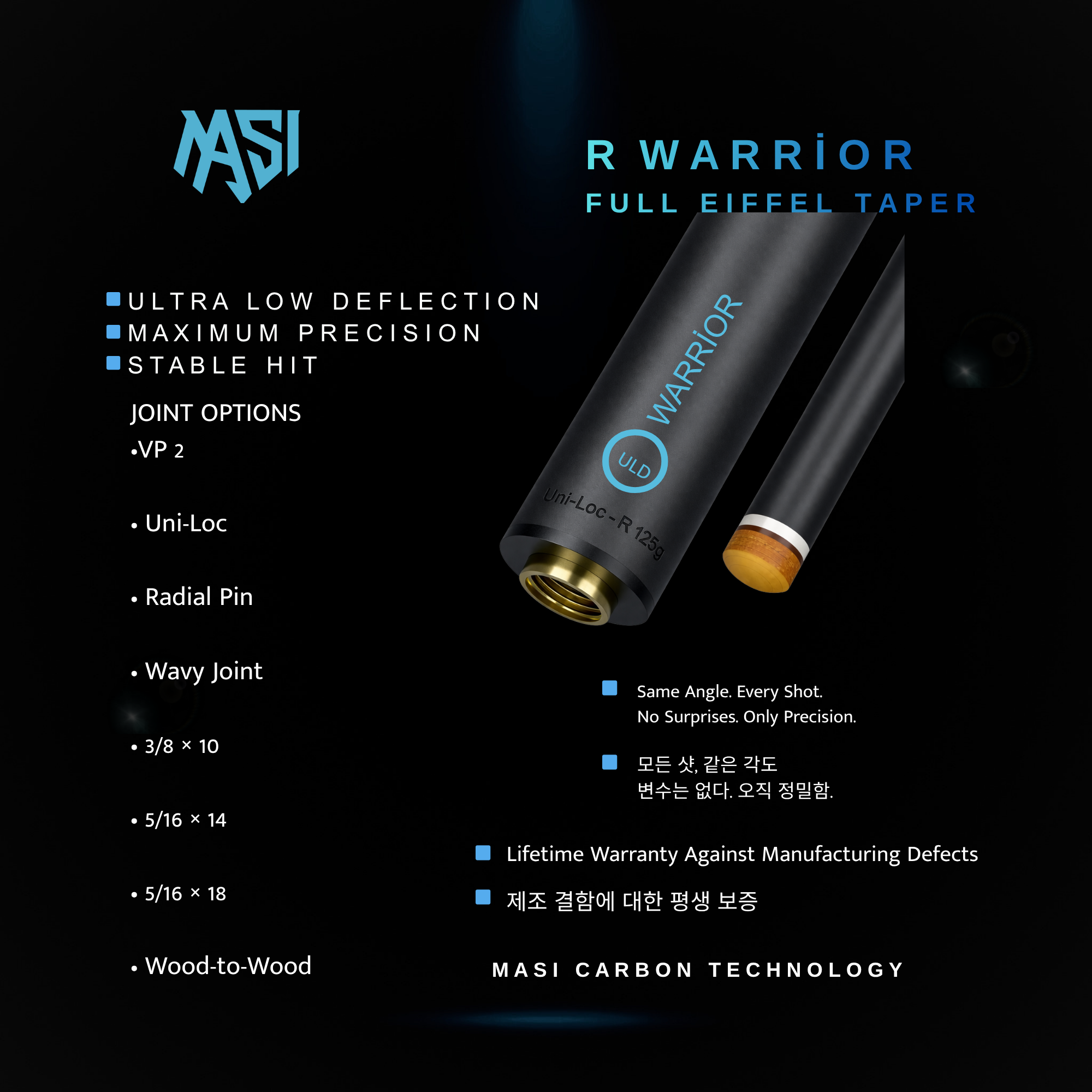
- R Warrior — full Eiffel taper, 105 – 160 g. Firm, crisp, repeatable.
- F Warrior — half Eiffel taper, 105 – 160 g. Gentle transitions, graduated feedback.
- C Warrior — conical taper, 105 – 160 g. Classic geometry, direct power transfer.
All three are used in carom; the choice depends on your stroke tempo more than on the discipline. Decision table in the R/F/C comparison.
Tip diameter and tip type
Warrior shafts sit in the 11.9 – 12.2 mm band with Gorina M as the standard tip and alternatives on request. See the tip diameter guide.
Joint compatibility
If you are buying only a shaft for an existing carom cue, matching joint standards is a precondition. Warrior shafts can be made for every joint type — you just state your cue's joint when ordering, or send a photo of the thread if you are unsure.
A Masi Carbon setup for carom
Both the Zafira and Titan X series are specified for carom and pool; there is no separate "carom body". What changes with discipline is sizing: weight, balance and shaft model. At order time you set butt colour and length, weight, joint type, shaft model and tip, extension options and an optional second shaft.
Switching to carbon
If you have played wood for years, the conical taper (C Warrior) disturbs your habits least during the transition. For humidity behaviour, consistency and maintenance differences, see carbon vs wooden cues.