What Cues Do Professionals Use? How to Verify Equipment Claims

Why claims about players' equipment are so often wrong, how to verify them, and why copying a professional's setup does not work.

What Cues Do Professionals Use? How to Verify Equipment Claims

"What cue do the champions use?" is asked constantly online, and a large share of the answers rest on no verifiable source. This article covers two things: how to verify such information, and how much it helps you even when it is correct.

Why these claims are so often wrong

Contracts change. Sponsorships usually run yearly. What was true one season may not hold the next, while the list circulating online never gets updated.

The brand is visible, the configuration is not. You may see a logo on a broadcast, but not the weight, balance point, shaft model, tip type or joint standard — and those are exactly what determine the feel.

Custom builds are common. Top players' equipment is often not identical to the catalogue product, so "player X uses brand Y model Z" is usually an incomplete description.

The chain of retelling is long. A forum comment becomes a news item, then a blog post, and the source disappears. That is why we publish no equipment claims about other brands' athletes.

How to verify

  • The player's own statement: an interview, a social post or an official sponsorship announcement.
  • The brand's own roster page: serious brands list the players they sponsor on their own site.
  • Federation and tournament records: not equipment, but participation and results can be verified here.

Anything outside these three is second-hand. If a page making a claim cites no source, do not treat it as verified.

Even if it is true: why copying does not work

A player's equipment only makes sense together with their stroke tempo, bridge height, arm length and habits. Buying the same cue and expecting the same result is like expecting the same running speed from the same shoes.

To actually benefit, target the measurements rather than the brand:

  • Weight: matched to your stroke tempo (we build within 380 – 600 g)
  • Balance point: forward feels planted, rearward feels agile
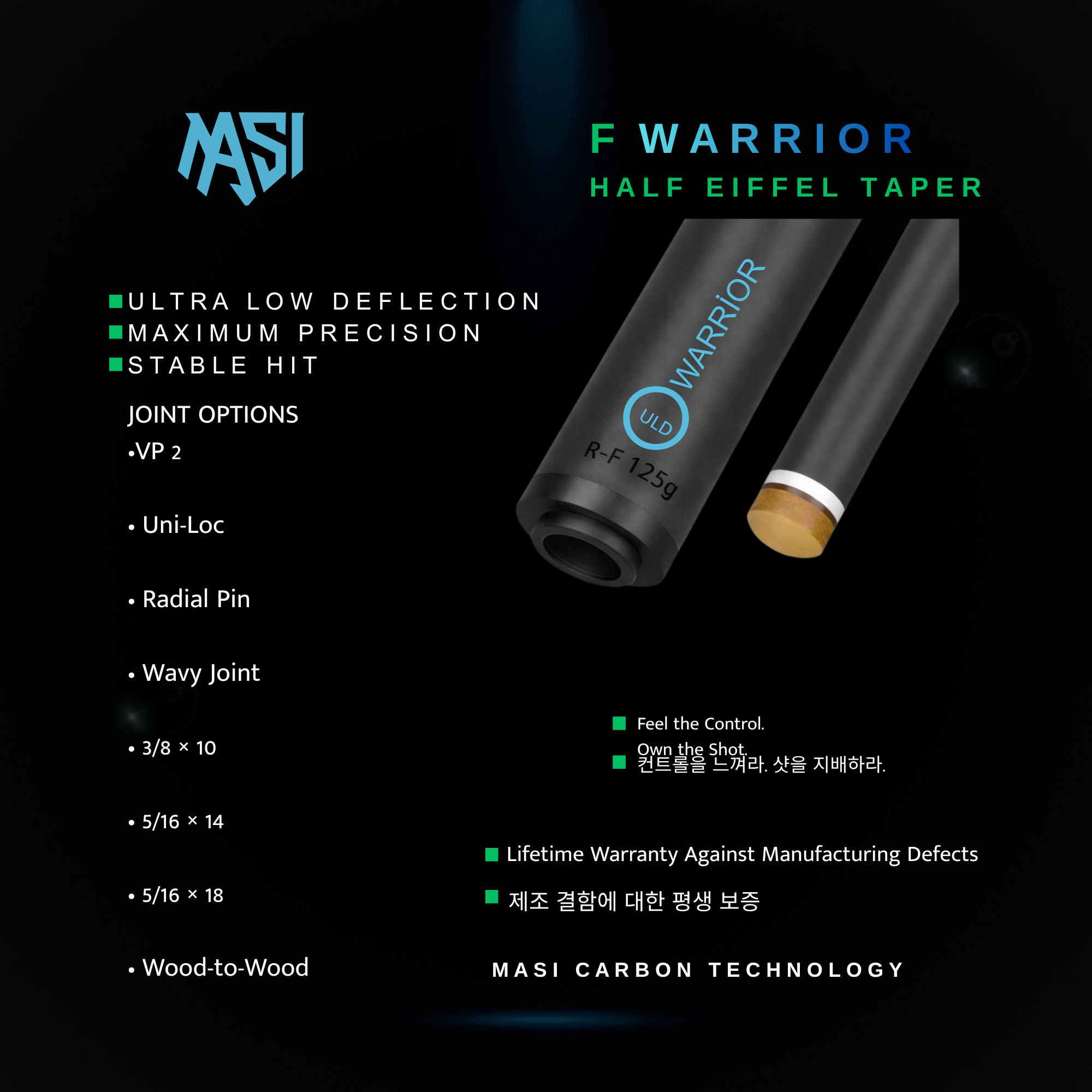
  • Taper profile: the main driver of feel — full Eiffel (R), half Eiffel (F) or conical (C)
  • Tip diameter: the contact feel you are used to (11.9 – 12.2 mm on Warrior shafts)
  • Joint standard: compatibility with your existing cue

Once these five are settled, which brand you buy becomes a secondary decision. The full set of criteria is in our ten criteria article.

How real is the shift to carbon?

That carbon shafts have spread through both pool and carom is observable. But most of the "70% of professionals" style figures circulating online are unsourced, and we do not publish such numbers either.

The technical reasons behind the shift — squirt, consistency, vibration and durability — are explained at mechanism level in a separate article.

Players who play with Masi Carbon

We publish the players we work with directly, and their profiles, on the Pro Team page; the roster includes carom players from Türkiye and Korea. That information rests on our direct collaboration with those athletes.

Summary

Researching champions' equipment is a curious starting point but a weak basis for a purchase. Settling your own measurements — weight, balance, taper, tip diameter and joint — always produces a better outcome. See our sizing guide.

Related posts

WhatsApp