Why Do Professionals Use Carbon Shafts? Four Technical Reasons
The technical reasons carbon shafts spread through professional play — squirt, consistency, vibration and durability — and what they mean for amateurs.
Carbon shafts have spread through both pool and carom in recent years. This article covers the technical reasons behind that — not who uses which brand, but what the material does to the game.
Note: third-hand claims about which equipment a given player uses are frequently wrong, and contracts change season to season. We therefore make no claims about other brands' players and name only the players we work with directly.
1. Less squirt on side-spin strokes
When you apply side spin the tip contacts the ball off-centre and the cue ball leaves your aiming line by some amount. The size of that deviation relates to the mass in the front end of the shaft: a lighter front end means less squirt.
That is precisely what carbon fiber enables — the same stiffness with less mass up front. Since many decisive shots involve spin, less squirt translates directly into repeatability.
2. Consistency across humidity and temperature
Wood is hygroscopic: it takes on and gives off moisture. Long-term that means warping; short-term it means the feel changes from room to room and season to season.
Carbon does not behave that way. In a tournament, in another city or across a winter-to-summer swing, the cue feels the same. Removing equipment as a variable lets a player focus on their own form.
3. Vibration behaviour
The vibration travelling along the shaft at contact is part of the feedback a player receives. A carbon composite structure manages how that vibration decays differently from wood, producing more controlled and repeatable feedback.
"Different" is more accurate than "better" here: some players prefer the softer, more diffuse feedback of wood. Carbon's advantage is giving you the same feedback every time.
4. Durability and maintenance
A carbon shaft neither swells nor shrinks with moisture, so it carries no warping risk and needs no sanding. Periodic surface maintenance gradually thins a wooden shaft's diameter; a carbon shaft holds its dimensions.
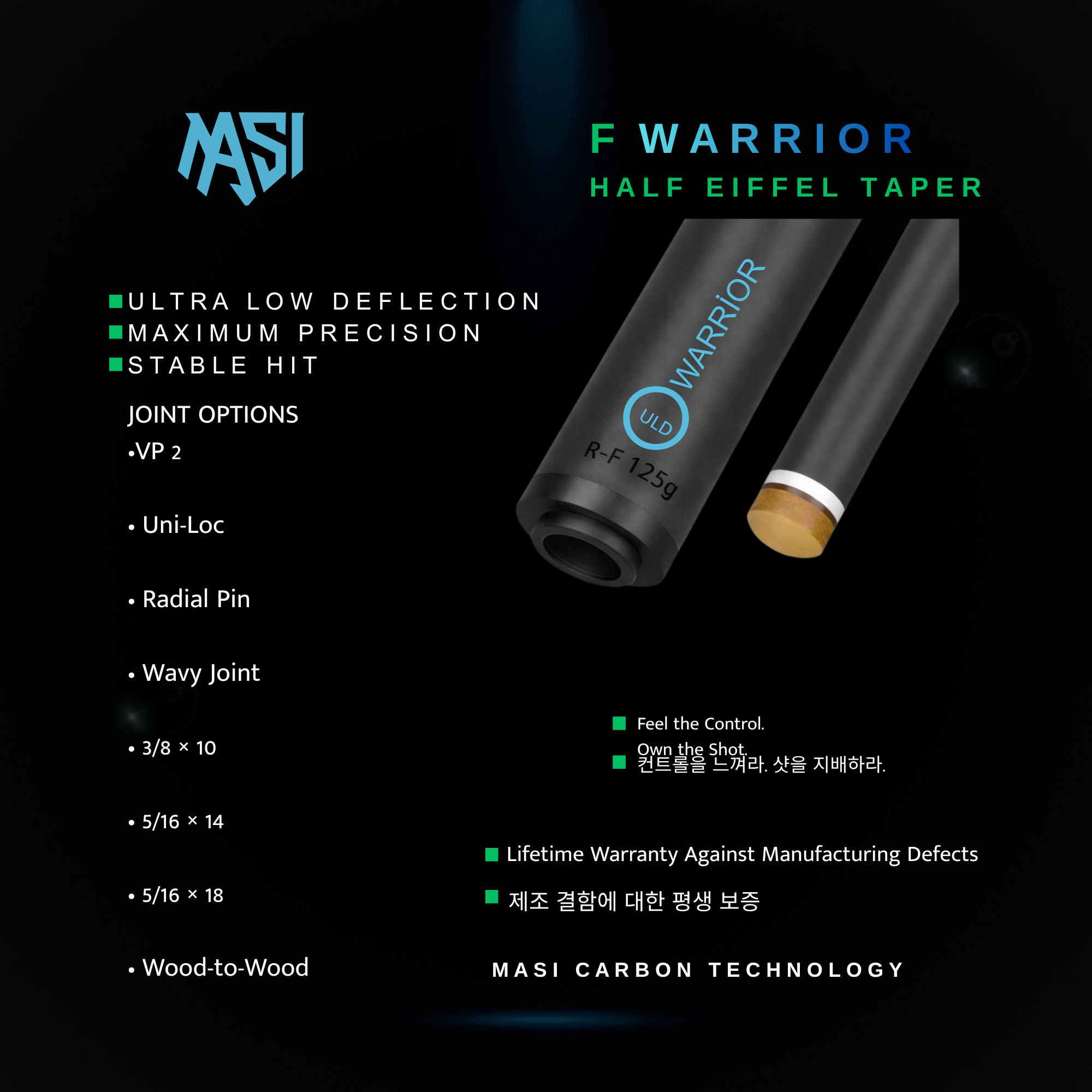
That is the engineering logic behind the lifetime manufacturing-defect warranty on Masi Carbon Warrior shafts. Care details are in the care guide.
What about differences between brands?
Being carbon is not enough on its own. Two shafts made from the same material can feel completely different because of taper profile and weight distribution. In the Warrior family those profiles are full Eiffel (R), half Eiffel (F) and conical (C) — see the shaft technology article.
So "professionals use carbon" is a starting point, not a choice. The real decision is about taper and weight.
Players who play with Masi Carbon
We publish the profiles and configurations of the players we work with directly on the Pro Team page. The roster includes carom players from Türkiye and Korea. We make no claims about other brands' athletes — that information can only be verified by the player or the brand themselves.
What it means for an amateur
None of the four points above require a professional level. Humidity consistency and squirt behaviour work the same way for someone playing twice a week.
The difference is what you do with it: a professional converts the gain into points, while an amateur uses it to make learning easier — with less variability coming from the equipment, the source of an error becomes clearer.
For the switching decision see carbon vs wooden cues, and for model choice the R/F/C decision guide.