Choosing a Carbon Billiard Cue — 10 Criteria That Matter (2026)
The ten criteria to check before buying a carbon cue. Not a ranking list — a checklist so you can make the call yourself.
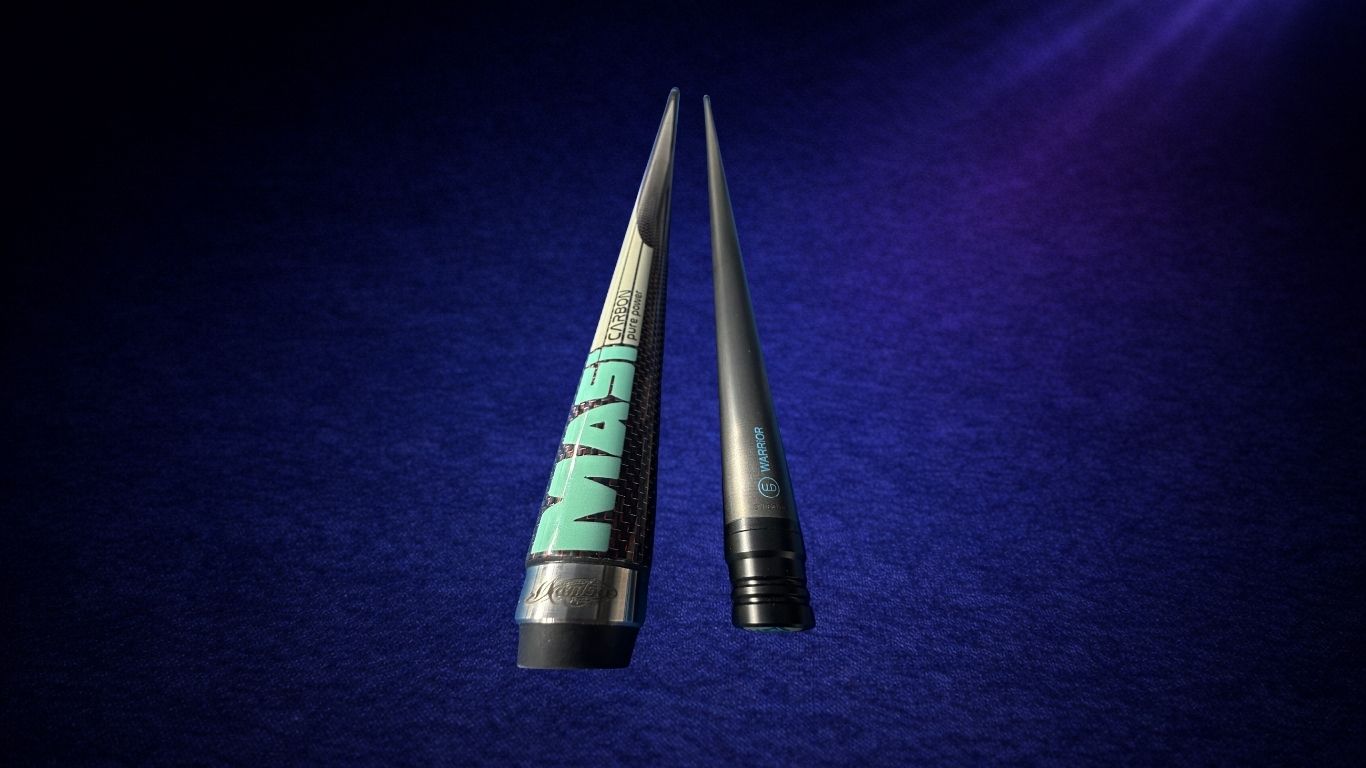
There is no single right answer to "which carbon cue is best" — "best" depends on your stroke, your discipline and the equipment you already own. Instead of a ranking, this article lists the ten criteria to evaluate any carbon cue against.
Disclosure: Masi Carbon is a manufacturer. That is why we do not publish a ranking that scores competitors; we share the criteria so you can decide for yourself.
1. Taper profile
The geometry describing how the shaft thickens from tip to joint. It is the single biggest factor in how a cue feels. Two shafts of the same diameter can feel completely different because of taper alone. If the product page does not name the taper, ask the seller. (In the Warrior family the profiles are full Eiffel, half Eiffel and conical — see the shaft technology article.)
2. Tip diameter
Diameter affects the contact area and how side spin feels. Discipline and habit decide — thinner is not automatically better. Warrior shafts sit in the 11.9 – 12.2 mm band. See the tip diameter guide.
3. Total weight and adjustability
As important as the weight itself is whether you get to choose it when ordering. Shelf products come at a fixed weight; made-to-order cues do not. Masi Carbon cues are built to any weight within 500 – 600 g.
4. Balance point
Two cues of the same weight can feel different because of where the mass sits. A forward balance feels self-propelling, a rearward balance more agile. The full relationship is in the weight guide.
5. Shaft weight
Most buyers only look at total weight, but the mass on the shaft side shifts balance directly. In the Warrior series, R is 105 – 160 g while F and C sit at 105 – 160 g.
6. Joint compatibility
Critical if you plan to fit the shaft to an existing butt. Manufacturers use different joint standards and an incompatible pairing simply will not work. Warrior shafts can be produced for every joint type — see the joint standards article.
7. Tip choice and replaceability
The tip is the only part touching the ball and it wears out. Ask two questions before buying: which tip does it ship with, and can you request a different one? Warrior shafts ship with Gorina M as standard, with alternatives on request.
8. Warranty scope
"Has a warranty" means little on its own — what it covers is what matters. A manufacturing-defect warranty is not the same as impact cover. Masi Carbon shafts carry a lifetime defect warranty and cues an unlimited one, covering production faults.
9. Service and parts access
A carbon cue is a long-term purchase; the real question is who you contact in five years for a second shaft, an extension or a tip change. With overseas brands, shipping and customs stretch that process out.
10. Clarity of measurements before ordering
In a good buying process nothing is left to guesswork. Weight, length, joint type, shaft model and tip should all be settled at order time. On our site these are mandatory fields — an order cannot be created with missing measurements, and they remain editable in the cart.
Mapping the market
We compiled an overview of carbon shaft and cue manufacturers in the carbon cue brands article. We do not quote prices there because price and model lines change often — verify current details on each maker's own site.
Should you switch to carbon at all?
That question comes before this list. The real differences — humidity behaviour, consistency of feel, maintenance and cost — are compared in carbon vs wooden cues.