Choosing a Pool Cue 2026 — A Sizing Guide for 9-Ball and 10-Ball
Choosing a cue for 9-ball and 10-ball: how to decide on tip diameter, weight, balance, taper and joint — and what a carbon shaft actually changes.
Pool — 9-ball and 10-ball in particular — is a discipline decided by position play. Arriving at the right angle on the next ball is often harder than potting, and that changes what you want from a cue: predictability over power.
1. Tip diameter
Tip diameter affects the contact area and the feedback you get when applying side spin. Pool players often gravitate to slimmer diameters than carom players, but "thinner is always better" is not a rule — what matters is the contact feel you are used to. Warrior carbon shafts sit in the 11.9 – 12.2 mm band; see the tip diameter guide.
2. Weight
The common tendency in pool is a cue that is not too heavy and swings quickly, because delicate position strokes put control first. It remains personal, though: a player who likes a hard break may want more mass. Masi Carbon cues are made to order within 380 – 600 g, so you set the weight — see the weight guide.
3. Balance point
Two cues of the same weight can feel "heavy" or "agile" depending on where the mass sits. A forward balance carries the stroke; a rearward balance feels more agile and controlled, which position players tend to prefer. You can also tune balance through shaft weight — a heavier shaft moves balance forward.
4. Taper profile
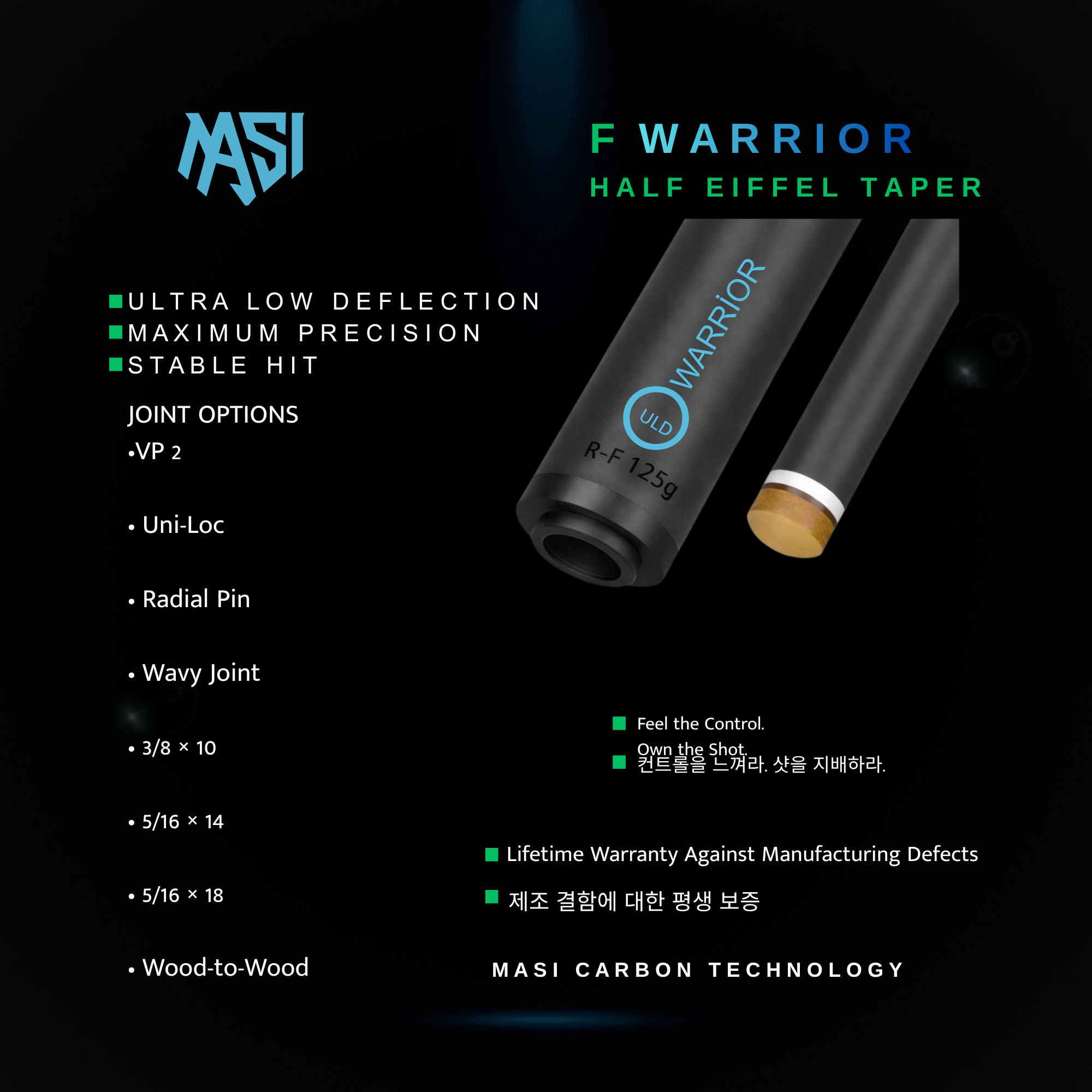
- F Warrior — half Eiffel taper (120–130 g). Gentle transitions, graduated feedback; frequently chosen by touch- and position-focused pool players.
- R Warrior — full Eiffel taper (120–160 g). Firm and crisp; reports clearly what happened on a powerful stroke.
- C Warrior — conical taper (120–130 g). Classic geometry with direct power transfer; the most familiar profile for players coming from wood.
Details in the shaft technology article and the R/F/C comparison.
5. Joint type
Buying a complete cue, you specify the joint at order time. Fitting a carbon shaft to an existing butt makes it a precondition instead: the shaft's joint standard must match your cue. Warrior shafts can be produced for every joint type — see the joint standards article.
Is there an equipment difference between 9-ball and 10-ball?
No. Both games use the same table, the same balls and the same cue; the difference is in the rules and strategy. The call requirement and the extra ball in 10-ball make position planning harder — that is a matter of game discipline, not equipment. There is no separate "10-ball cue" category to look for: whatever sizing is right for 9-ball is right for 10-ball.
What a carbon shaft changes in pool
On a side-spin stroke the tip meets the ball off-centre and the cue ball squirts off the aiming line. The size of that deviation is related to the mass in the front of the shaft; a lighter front end means less squirt. In a discipline dominated by position play, that means repeatability.
The second difference is consistency: carbon is far less affected by humidity and temperature than wood, so the cue feels the same when the room or the season changes. Full comparison in carbon vs wooden cues.
A Masi Carbon setup for pool
Our range does not split cue bodies between pool and carom — both the Zafira and Titan X series are specified for carom and pool. What changes with discipline is sizing: weight, balance and shaft model.
For a position-focused pool player, F Warrior with a mid-range weight is a common starting point; harder hitters may prefer R Warrior and a heavier shaft. Current models and pricing are on the products page.
Note: this guide references products we manufacture. We do not publish rankings scoring competitors — the evaluation criteria are collected in our ten criteria article.