What is a Carbon Fiber Billiard Shaft? Advantages and Manufacturing
We explain the structure of a carbon fiber billiard shaft, manufacturing process, advantages over traditional maple shafts and who they suit.
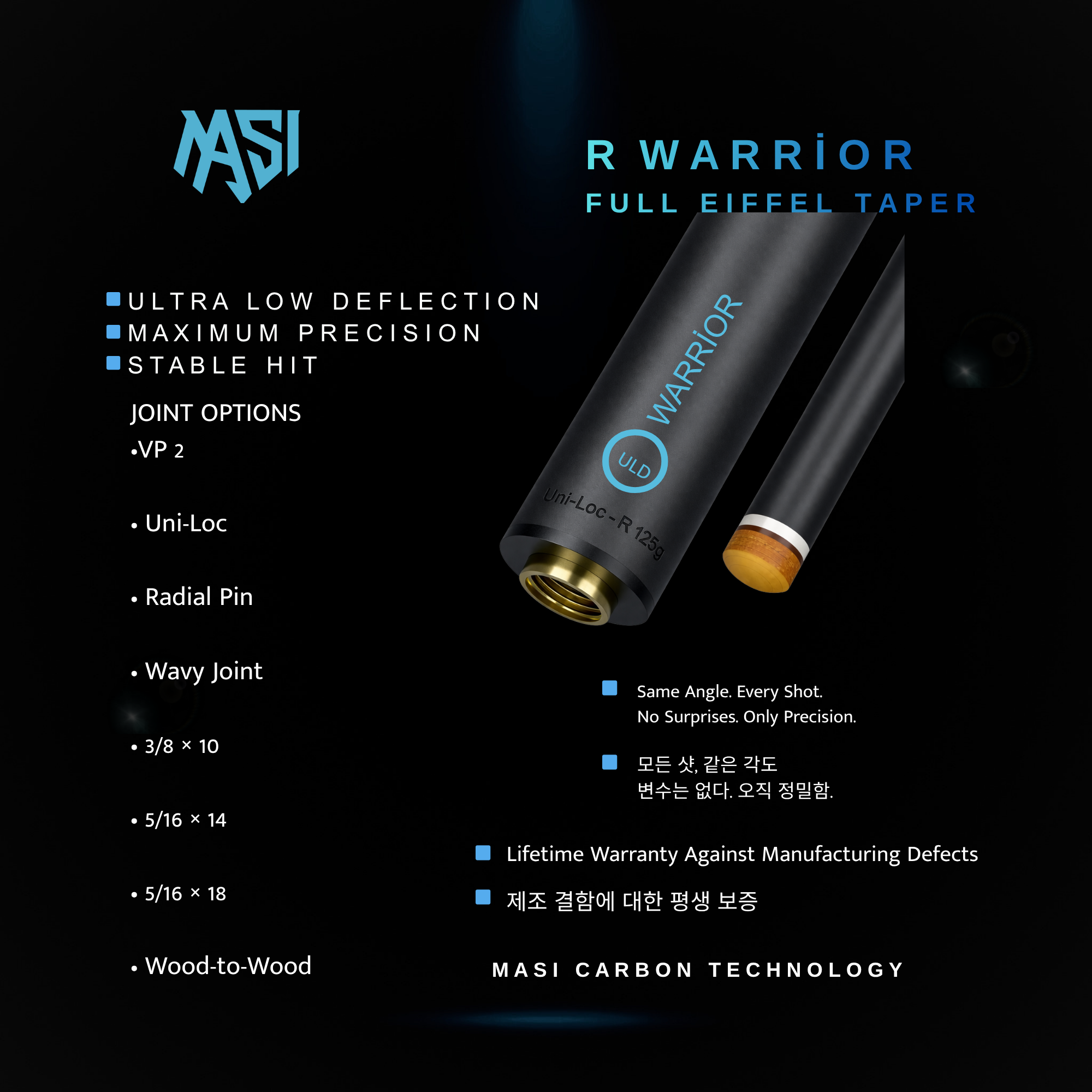
TL;DR — A carbon fiber billiard shaft is a billiard implement made from composite material — carbon fibers bonded with epoxy resin. Compared to traditional maple shafts it offers low deflection, humidity- and temperature-resistant structure, and long lifespan (15-20+ years).
What is a Carbon Fiber Shaft?
A carbon fiber shaft applies composite technology — borrowed from modern aviation and motorsports — to the world of billiards. Carbon prepreg layers are laid into the mold with controlled fiber orientation and cured in autoclave at 120-180 °C under pressure. The result: high strength, low weight, isotropic durability.
Manufacturing Process Stages
Premium carbon shafts like Masi Carbon Warrior go through these stages:
- Prepreg Preparation: Carbon fibers are impregnated with epoxy resin and stored cold.
- Layup: Prepreg layers are laid in the mold with controlled fiber orientation (typically 0°, ±45°, 90°).
- Autoclave Curing: 120-180 °C, 6-8 bar pressure for 4-6 hours. This stage determines the composite's final stiffness and durability.
- CNC Machining: The cured blank is machined into a conical or linear shape based on tip diameter.
- Balance Tuning: Shaft weight and balance point are tuned to specification.
- Grip Wrapping and Finishing: Hand-applied by master craftsmen.
- QA Testing: Each shaft is individually tested, certificate serial assigned.
Three Core Advantages of Carbon Fiber
1. Low Deflection: Lateral tip movement is minimal when applying english. This reduces cue ball deflection on long-distance positional shots.
2. Humidity and Temperature Resistance: Maple shafts can warp in environments above 40% humidity. Carbon fiber composite does not absorb water molecules — performance stays consistent in any environment.
3. Long Lifespan: Maple shafts have a 5-7 year usable life, while carbon fiber shafts exceed 15-20 years. Only the tip is replaced on average every 1-2 years.
Which Players Are They Suitable For?
Professional and semi-pro players: The most appropriate user base since they seek consistent performance.
Frequent traveling players: Stable performance across different climate and humidity conditions.
Long-term investment: Despite the high entry cost, a carbon shaft requires no additional spending for 10+ years.
Diameter Selection by Discipline
Suitable diameter ranges by discipline:
- Carom / 3-cushion: 11.9 – 12.2 mm
- Pool (8-9-10 ball): 11.75-12.4 mm
- Snooker: 9.5-10.0 mm (specialty product)
Conclusion
The carbon fiber billiard shaft is one of the most significant technological advances in modern billiard equipment. Despite the premium price tag, it is the most logical long-term investment. Visit our Warrior Shaft Series page to explore Masi Carbon's carbon fiber shaft lineup.