Carbon Shaft Ferrule Types and Importance
The least discussed part of a cue and one of the most consequential — how ferrule material and length shape tip support and deflection.
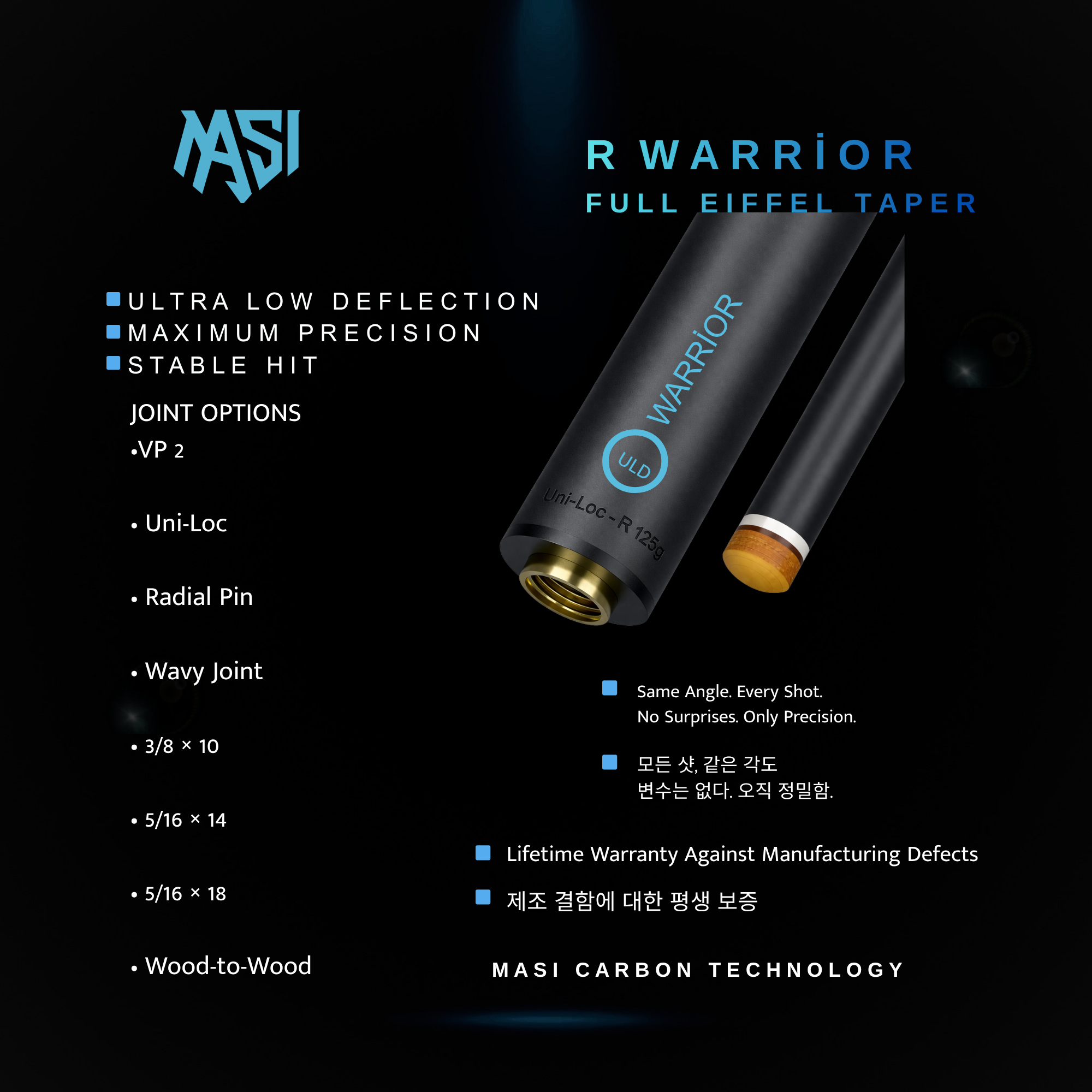
The ferrule is the small collar between your shaft and your tip. It is the least discussed component of a cue and one of the most consequential: it supports the tip, absorbs impact, and quietly determines how much your cue ball squirts off line. Get it wrong and you feel it on every shot without knowing why.
What a Ferrule Actually Does
Three jobs, all at once:
- It supports the tip. The tip is glued to the ferrule face. If that face is not flat and true, the tip cannot compress evenly.
- It protects the shaft. Impact energy that would otherwise split the shaft end is taken by the ferrule.
- It adds mass exactly where mass hurts most. Everything at the front end of a cue contributes to deflection. A heavy ferrule works directly against low-deflection design.
That third point is why ferrule material became a serious engineering question rather than a cosmetic one.
Ferrule Materials Compared
Brass
The traditional choice on older cues. Durable and easy to machine, but dense — precisely the wrong property at the tip end. Unsuitable for a low-deflection carbon shaft, where the entire design intent is to reduce front-end mass.
Ivory
Historically prized for its feel on premium wooden cues. Today it is restricted by international trade law, ethically indefensible, and irrelevant to carbon construction. Mentioned here only because it still appears in vintage listings.
Phenolic and other plastics
Lighter than brass and considerably cheaper. Workable on mid-range cues, and genuinely appropriate on break shafts, where hardness matters more than deflection. On a playing shaft it is a compromise rather than an optimum.
Composite ferrules
The modern standard for carbon shafts: engineered to be light, hard and dimensionally stable, so the tip is supported without loading the front end. This is the construction used on our Warrior carbon shafts.
Ferrule-less designs
Some carbon shafts omit a separate ferrule entirely and bond the tip to a reinforced shaft face. This minimises front-end mass but makes tip replacement a job strictly for a qualified fitter.
| Material | Front-end mass | Durability | Suited to |
|---|---|---|---|
| Brass | High | High | Vintage and budget wooden cues |
| Phenolic | Medium | High | Break and jump shafts |
| Composite | Low | High | Carbon playing shafts |
| Ferrule-less | Lowest | Varies | Specialist low-deflection builds |
Ferrule Length and Feel
Length is a second variable, independent of material. A shorter ferrule keeps mass down and favours low deflection; a longer one spreads impact load over more of the shaft end and can feel more solid at the cost of squirt. Neither is universally correct — it is part of how a maker tunes a shaft's character, alongside taper.
How Ferrules Fail
- Cracking. Usually from breaking with a playing shaft, or from a tip that was fitted while the ferrule face was out of square.
- Chipping at the edge. Almost always caused by an undersized tip leaving the ferrule rim exposed to contact.
- Loosening. Rare on modern bonded construction, but possible after heavy impact.
- Discolouration. Cosmetic on most materials — but if it appears alongside a change in sound or feel, have the shaft looked at.
Practical Advice
- Match your tip diameter to the ferrule. Our shafts run 11.9 – 12.2 mm; an undersized tip is the most common cause of ferrule damage we see.
- Do not break with your playing shaft. Ferrule cracks from break shots are avoidable and not covered as normal wear by most makers.
- Have tips fitted by someone competent. Facing a ferrule true is the part amateurs get wrong, and it cannot be corrected afterwards by shaping the tip.
- Do not sand the ferrule. Cleaning it is fine; reducing its diameter to match a tip is not.
- Treat a cracked ferrule as urgent. Playing on it transfers impact straight into the shaft end.
If you are choosing a shaft and want to compare construction rather than marketing copy, the ferrule is one of the specifications worth asking about directly. See our carbon shaft buying guide for the rest of the list.