Cue Weight and Balance: What to Choose?
Not a question with a right answer — only one that fits your stroke. And balance matters more than the number.
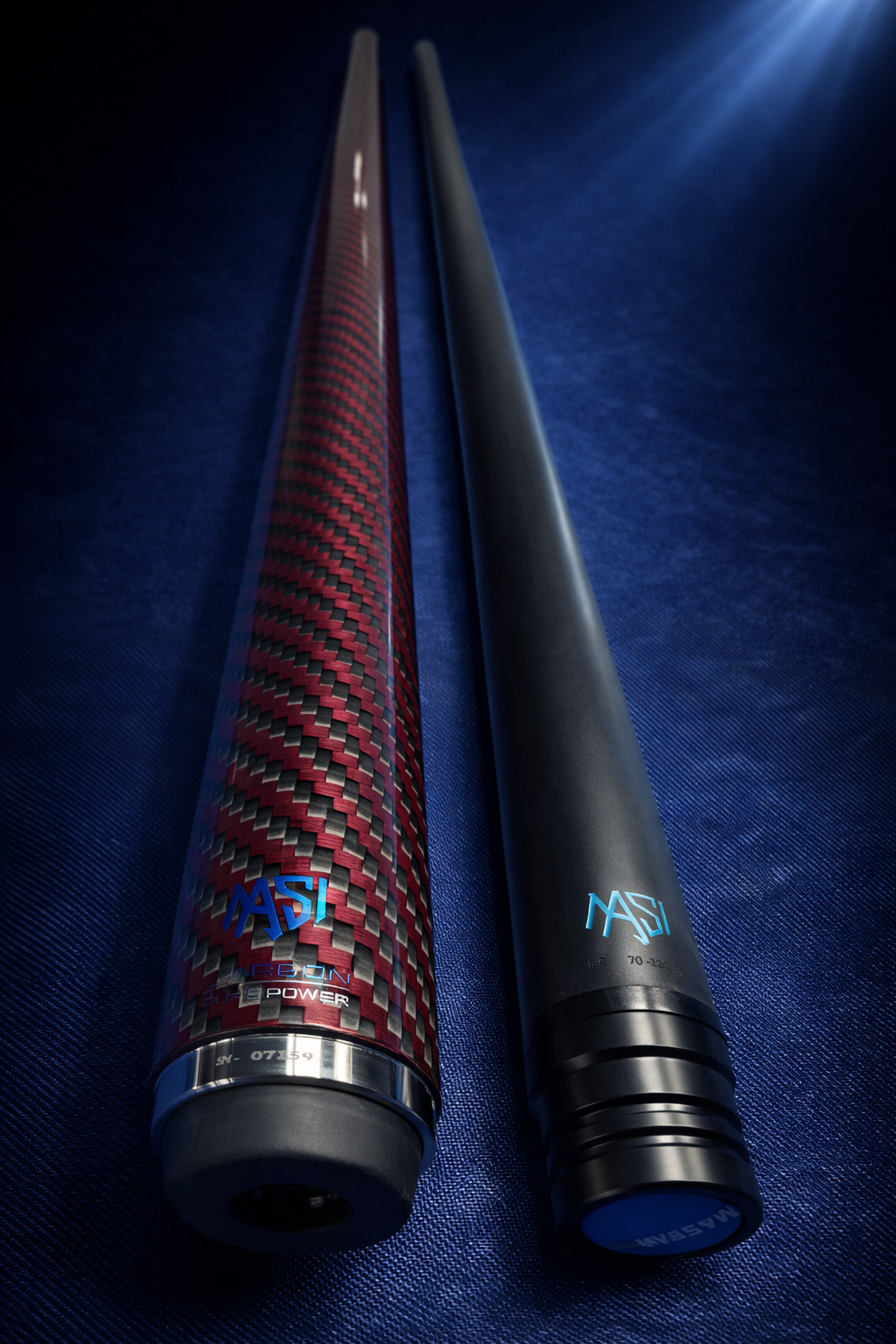
Cue weight and balance point change how a cue feels and how well you control it. They are also the two specifications beginners agonise over longest and approach most incorrectly — because this is not a question with a right answer, only one that fits your stroke.
What Weight Actually Changes
A heavier cue delivers more energy at the same stroke speed, but takes longer to accelerate. A lighter cue makes hand speed easier to generate, but transmits any wobble in your stroke just as faithfully.
- Heavier: the stroke feels slower and more settled, and the arm follows through naturally. Often helps players who rush the stroke.
- Lighter: easier to generate hand speed and fine touch. The stability has to come from your own stroke.
We build complete cues in the 500 – 600 g range, and shafts to any weight you specify between 105 and 160 g. The reason that matters is in the next section.
Balance Point — More Important Than Weight
Two cues of the same 500 g feel completely different depending on where that weight sits. The balance point is where the cue balances on a single finger.
| Balance | Feel | Suits |
|---|---|---|
| Forward | Head-heavy, a more solid hit | Power strokes, breaking |
| Centre | Neutral and predictable | Most players; the reference point |
| Rear | Light in the head, faster hand | Fine touch, position play |
Changing shaft weight moves the balance point. So being able to specify weight is really being able to specify balance: keep the butt as it is and adjust the shaft in grams to shift the balance where you want it.
Common Misconceptions
- "A heavier cue hits harder." Energy is weight combined with speed. A heavy cue swung slowly can deliver less than a light cue swung quickly.
- "Use the weight the pros use." A professional's weight is matched to their build and stroke. It is a reference, not a standard.
- "Changing weight will improve my game." Equipment does not fix a stroke. But equipment that does not fit will obstruct a good one.
How to Decide
- If you can, play 30 minutes with cues of different weights. A few shots tells you nothing.
- Judge on position shots, not power shots. Weight differences show up most clearly in soft control strokes.
- Once you find a comfortable range, stay in it. Frequent changes prevent a reference feel from forming.
- Then fine-tune the balance — which you do through shaft weight.
When Ordering
Our Warrior carbon shafts are built to any weight between 105 and 160 g, and you specify length and tip type at the same time. If you are unsure which weight suits you, tell us the weight and feel of the cue you play with now — starting from that is more accurate than reading a specification table.