Shaft Technology: R Warrior, F Warrior and C Warrior Differences
What is taper and how does it change the hit? The technical differences between the R Warrior full Eiffel, F Warrior half Eiffel and C Warrior conical profiles.
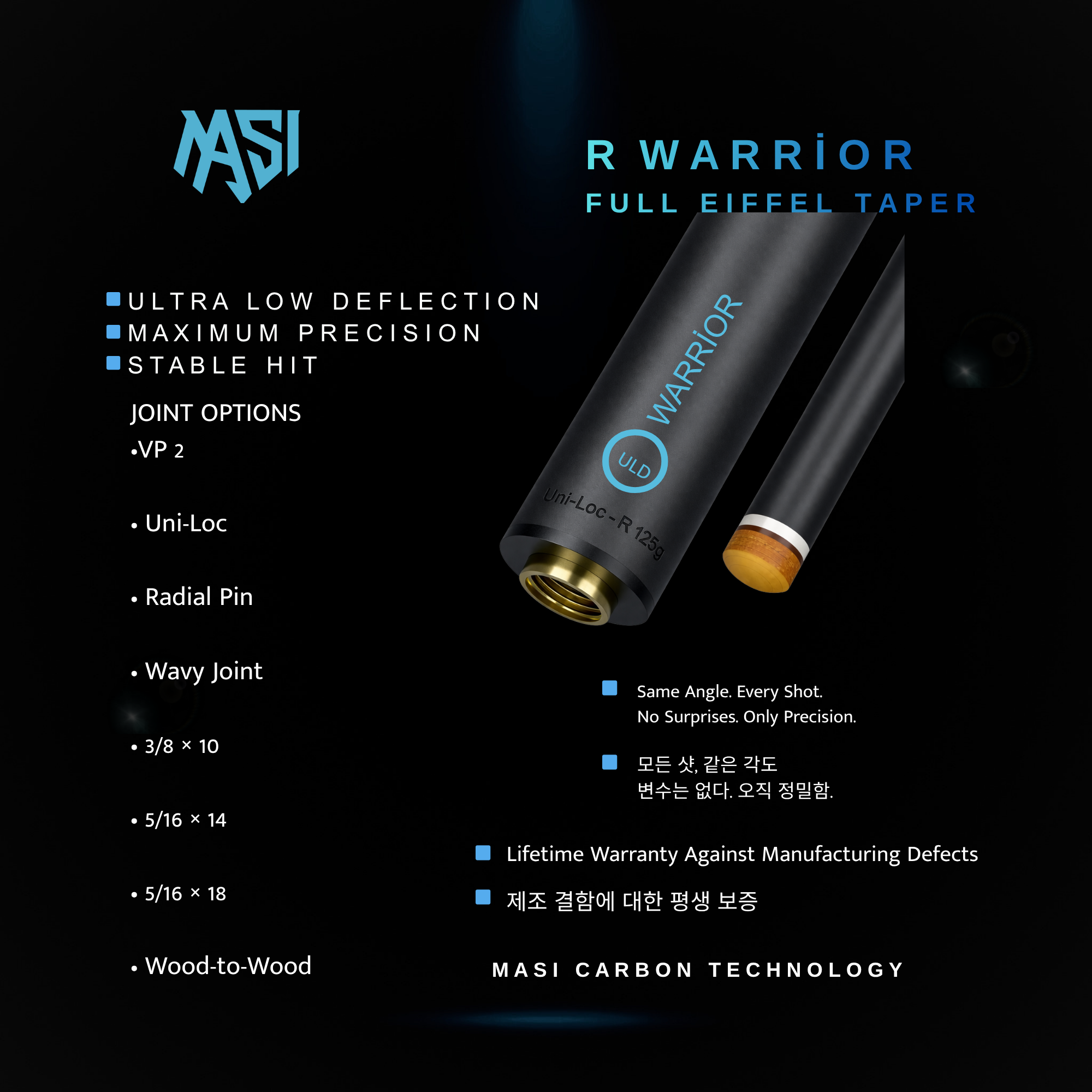
The Warrior carbon shaft family has three models: R Warrior, F Warrior and C Warrior. All three share the same carbon fiber body and the same dimensional ranges; what separates them is the taper profile. This article explains what taper is and how each profile changes the hit.
What is taper?
Taper is the geometry describing how the shaft's diameter changes from the tip toward the joint. The shaft starts thin at the tip and thickens toward the joint — where that thickening begins and along which curve it progresses defines the taper profile.
Taper affects two things directly: how the shaft slides through your bridge hand, and how much the shaft flexes and transfers energy at contact. Two shafts of the same diameter can feel completely different because of taper alone.
Specs shared by all three
- Body: carbon fiber
- Tip diameter: 11.9 – 12.2 mm
- Tip: Gorina M as standard; alternative tips available on request
- Joint: all joint types supported
- Length: standard production
- Warranty: lifetime against manufacturing defects
So the choice is not about diameter or joint compatibility — all three sit in the same diameter band and work with every joint type. The decision is entirely about taper and weight.
R Warrior — full Eiffel taper
Weight: 105 – 160 g (can be made to order)
The full Eiffel taper is the family's most pronounced profile. The product claim is that it delivers the same angular feel on every stroke with maximum stability — in other words, it is built around repeatability.
In practice this means firm, crisp feedback: you feel clearly what happened at contact. Players with an aggressive tempo who want the result of a stroke as a clear signal tend to pick this profile.
R Warrior also has the widest weight range in the family (105 – 160 g). If you want more mass on the shaft side, this is the only option — the other two are capped at 130 g.
F Warrior — half Eiffel taper
Weight: 105 – 160 g (can be made to order)
The half Eiffel taper softens R's geometry into an intermediate profile. The product description frames it as a balance between control and flex: transitions are gentler and the stroke feels smoother.
It suits players who prioritise touch. If you prefer graduated feedback over a hard signal — especially on thin cuts and delicate position play — F Warrior is the sensible starting point.
C Warrior — conical taper
Weight: 105 – 160 g (can be made to order)
The conical taper is billiards' most classic shaft geometry: diameter increases steadily from tip to joint. The product claim here is direct energy transfer and sharp stroke control.
For players who spent years on a wooden conical shaft and want that familiarity in a carbon body, this is the closest profile. It responds faster and more directly.
What "low deflection" means
On a side-spin stroke the tip contacts the ball off-centre and the cue ball squirts away from your aiming line. The size of that deviation is related to the mass in the front end of the shaft; the lighter the front end, the smaller the squirt. That is largely why carbon shafts became mainstream.
Warrior product descriptions also use the phrase "ultra low deflection". That is a product claim — we do not publish a numeric deflection coefficient, so when comparing brands we recommend trusting your own feel rather than a number.
Which one to choose
- Firm, crisp, repeatable feel plus more weight options → R Warrior
- Softer transitions and touch sensitivity → F Warrior
- Classic conical feel and direct power transfer → C Warrior
A decision table by playing style and discipline is in the Warrior R/F/C comparison. For diameter by discipline see the tip diameter guide, and for joint compatibility the joint standards article.
Buying a shaft on its own
Warrior shafts are sold separately: you can keep your existing butt and convert only the shaft to carbon. At order time you choose the shaft model, joint type, length, weight and tip. Current shaft pricing is on the products page.
If you are buying a Masi Carbon cue, the first shaft is included in the price; a second shaft is added to the order total at the shaft price.