Billiard Cue Selection: Beginner to Advanced Guide
The decisions that actually matter on a first cue — and the specification debates you can safely ignore until later.
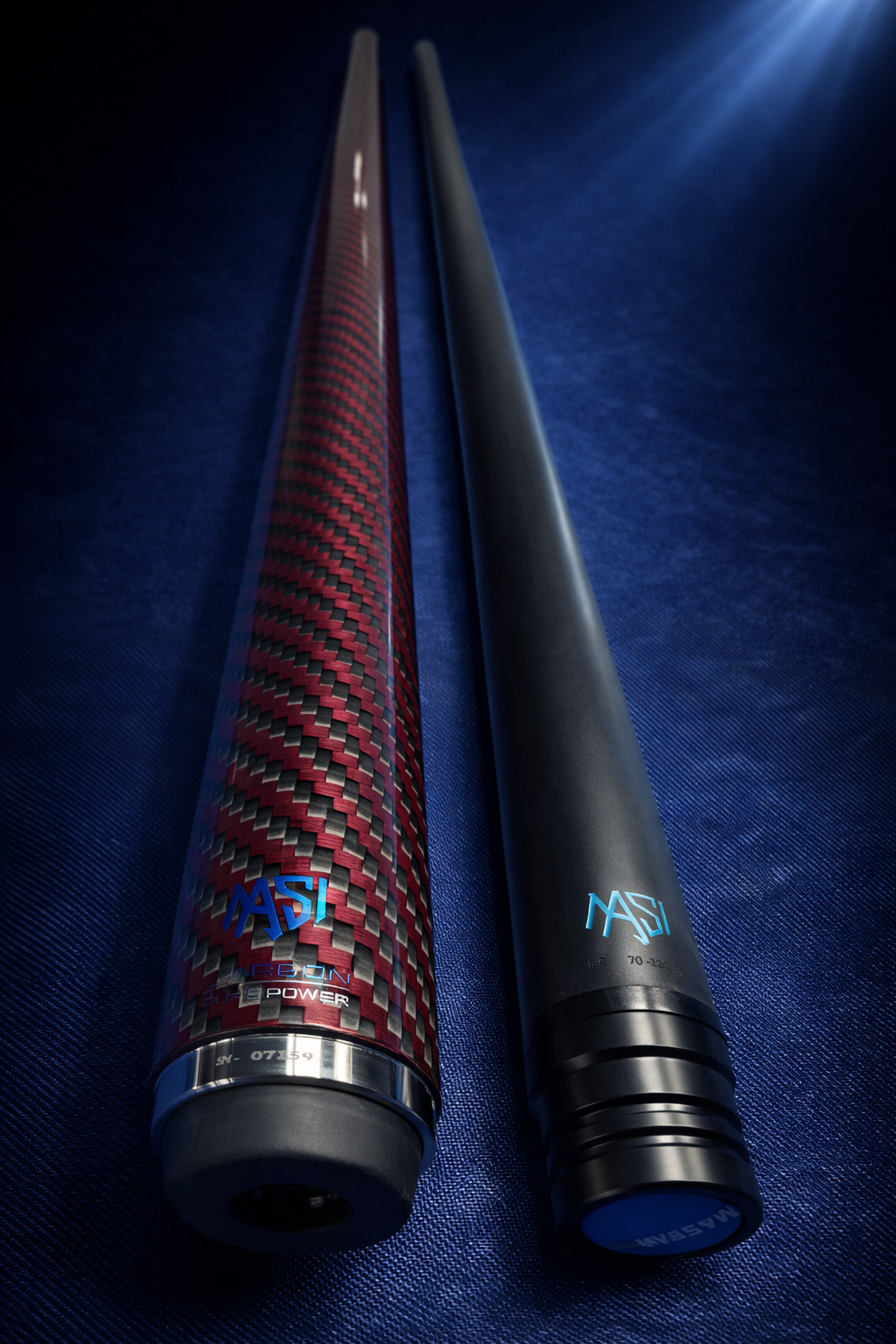
The first equipment question every new player runs into is this: should I buy a cue yet, and if so, what actually matters? This guide skips the fine-grained specification debates that occupy advanced players and covers only the decisions that count on a first cue.
First: Should You Buy One At All?
Playing on house cues for the first few months is not a bad idea. The right moment to buy your own is when house cues start getting in your way — worn tips, warped shafts, or the simple fact that playing with a different cue every session breaks your rhythm. Once you reach that point, owning a cue accelerates your technical development, because one variable has been fixed.
The Parts of a Cue
- Shaft: the front half. Your bridge hand slides on it and it dominates how the cue feels.
- Butt: the back half. Sets weight and balance.
- Joint: the threaded connection between them. Compatibility is decided here.
- Tip: the only part that touches the ball.
- Ferrule: the collar at the shaft end that supports the tip.
- Grip: the wrap where your back hand sits.
Weight — The Most Over-Analysed Number
Beginners agonise over this, but within a broad range it is preference. We build complete cues in the 500 – 600 g range, chosen by discipline and build. A heavier cue feels slower and more settled through the stroke; a lighter one makes hand speed easier to generate. Neither is correct, and hitting two or three is far quicker than reading specification tables.
Length
A standard adult cue suits most players. If you are unusually tall or short, adjusting length is worth considering — but check your stance first. A great deal of what looks like a length problem is actually bridge distance and stance. Our Warrior shafts can be specified to length at the point of order.
Tip Diameter
This follows your discipline. Carom generally runs narrower than pool. Our shafts are produced in the 11.9 – 12.2 mm range, covering the standard carom and pool tip sizes from the major brands. What matters is that tip and ferrule match precisely — an undersized tip leaves the ferrule rim exposed and will eventually chip it.
Wood or Carbon?
| Factor | Maple | Carbon |
|---|---|---|
| Humidity | Absorbs it; can warp | Unaffected |
| Unit-to-unit variation | Every piece differs | Near-identical within a run |
| Maintenance | Periodic sanding and sealing | Wipe clean |
| Entry cost | Can start lower | Generally higher |
| Feel | Traditional, varies by piece | Consistent, low deflection |
Carbon will not fix your stroke. It removes equipment variables so your own errors become visible — which, while you are learning, is an advantage rather than a drawback. Our Warrior carbon shaft is priced at 413 € and comes in three tapers chosen by feel: R (full Eiffel, 105 – 160 g), F (half Eiffel, 105 – 160 g) and C (conical, 105 – 160 g). All three support every joint type.
Decide the Discipline First
- Three-cushion carom: narrower tip, firmer tip, a taper suited to a long stroke.
- Pool: low deflection is the headline benefit; a slightly softer tip is typical.
- Break: a separate, stiffer shaft. Do not break with your playing shaft.
Common First-Cue Mistakes
- Spending the entire budget on the cue. Leave room for the tip, the fitting, and a case to protect it.
- Skipping the joint check. The joint decides your options when you later want a different shaft.
- Trying to fix technique with equipment. A new cue does not change your stroke.
- Changing too often. You only build a reference feel by staying with one cue long enough.
- Neglecting the tip. It is the cheapest maintenance with the largest effect.
What to Buy Alongside It
Chalk, a glove, a tip shaping tool and a case are the basic kit. Selection criteria for each are covered in our accessories catalogue and blog guides.
The summary is simple: decide the discipline, check the joint, hit one if you can, and leave budget for the tip. The rest you learn by playing.