Billiard Styles: Pool, Snooker and Carom Differences
Three different sports that share a name — and the equipment differences that follow from the rules.
Billiards is not one sport. Pool, snooker and carom differ in table size, rules and the skills they demand — and so does the equipment, which is why a cue suited to one feels wrong in another. Here is the comparison that actually matters.
Pool
The most widely played form, and the one found in clubs and bars. Larger pockets and a relatively smaller table make it the most accessible.
- Objective: pot balls in a defined order or according to the game's rules
- Common games: 8-ball, 9-ball, 10-ball
- Core skill: position play — potting while leaving yourself the next shot
- Equipment tendency: english is used constantly, so low deflection is a real benefit, and tips are generally a little softer
Snooker
The largest table and the smallest pockets. That combination makes snooker the most technically punishing of the three.
- Objective: build a break by alternating reds and colours
- Core skill: precise cueing and safety play
- Equipment tendency: the narrowest tips and lighter cues; hard tips dominate because the cueing is so fine
Carom (Three-Cushion)
Played with three balls on a table without pockets, and particularly strong in Korea and across Europe.
- Objective: strike both object balls with the cue ball, having contacted the cushions at least three times first
- Core skill: angle calculation and spin control — thinking three cushions ahead
- Equipment tendency: the stroke is heavy and sessions are long, so firm tips are standard and diameters run narrower than pool
Side by Side
| Pool | Snooker | Carom 3-cushion | |
|---|---|---|---|
| Pockets | Yes, large | Yes, small | None |
| Balls | 10 or 16 | 22 | 3 |
| Tip diameter | Medium | Narrowest | Narrower than pool |
| Tip hardness | Soft to medium | Hard | Medium to hard |
| Defining skill | Position play | Precision and safety | Cushion calculation and spin |
Does Switching Discipline Mean Switching Equipment?
Not entirely. What genuinely changes is mostly the tip: carom wants a firm one, pool a slightly softer one. The shaft itself travels between disciplines perfectly well provided the tip diameter suits and the joint fits.
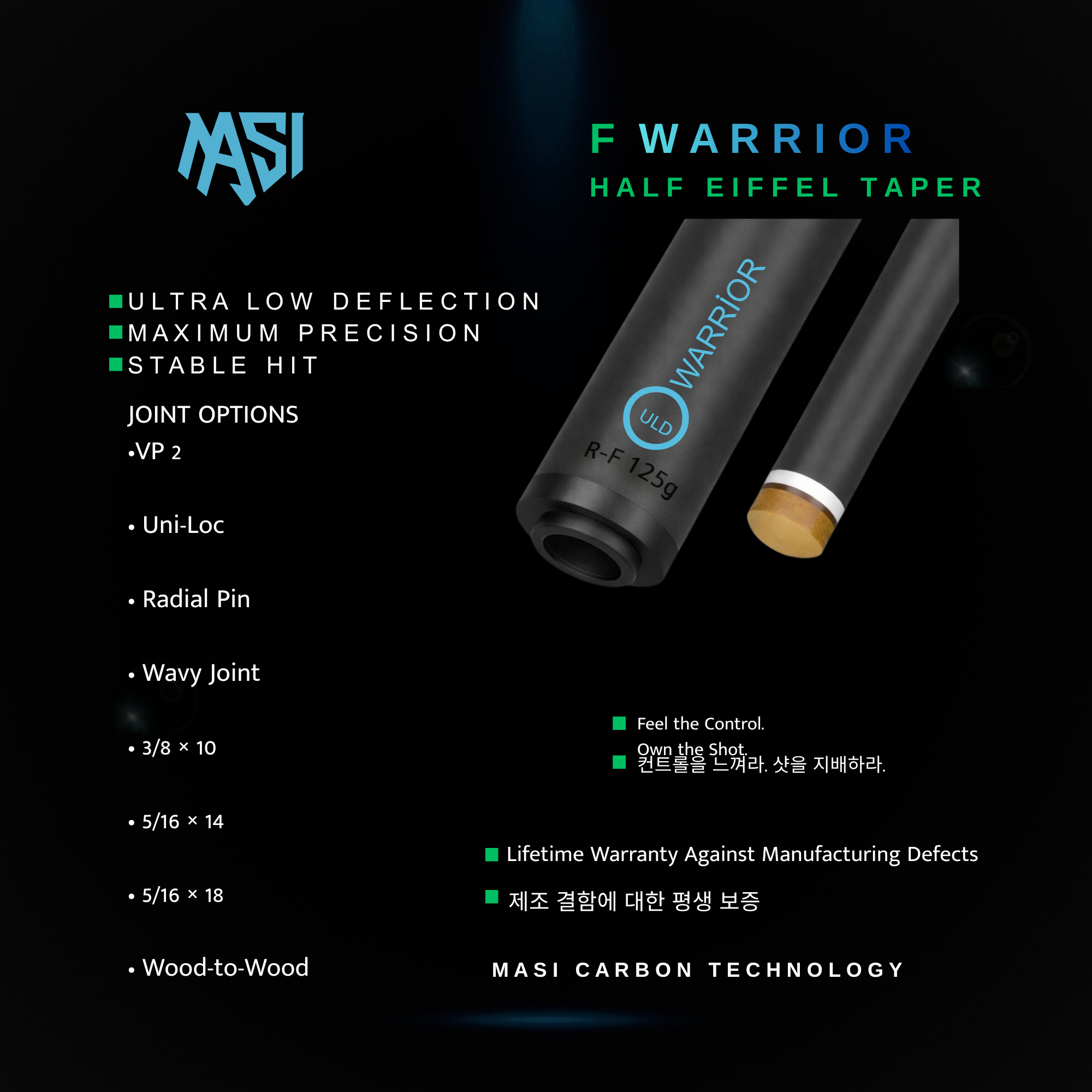
Our Warrior carbon shafts are produced at 11.9 – 12.2 mm, covering standard carom and pool tip sizes, and support every joint type. They ship with a Gorina M carom tip as standard, changeable on request. In practice this means moving between disciplines usually costs you a tip, not a shaft.
Where to Start
Pool is the easiest to pick up because the rules are intuitive. Carom — three-cushion in particular — has deep roots in Korea and much of Europe, with good club access. Snooker tables are the hardest to find outside countries with an established scene. Whichever you choose, time spent on your stroke will improve you faster than time spent on equipment — see our beginner guide for that side of it.