What Is a Carbon Shaft? Differences Between Spelling Variants
Carbon shaft, carbon saft, carbon şaft — three different spellings, same product. Learn what a carbon fiber billiard shaft is, how it's manufactured, and why it outperforms traditional maple.
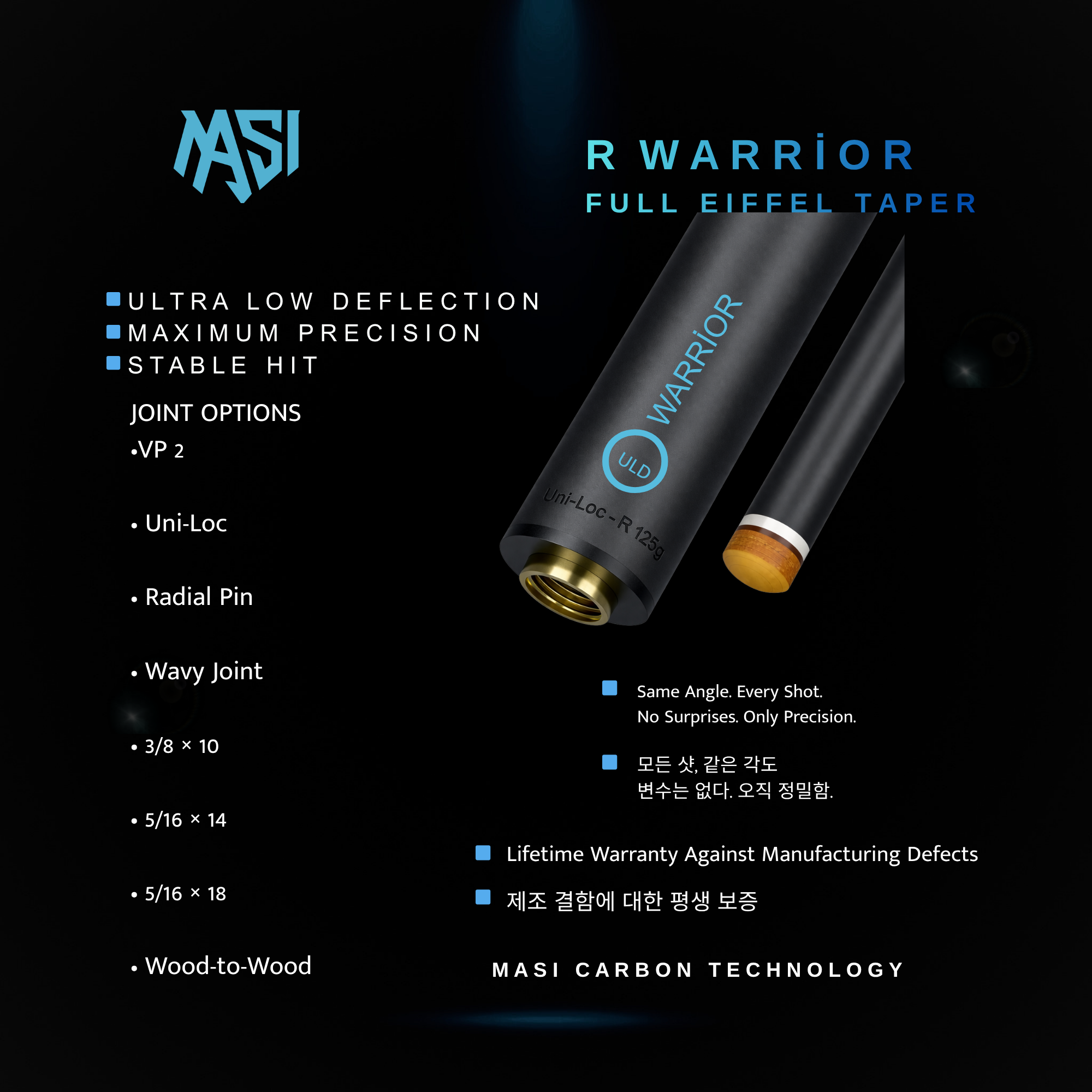
Carbon shaft, also written as carbon saft or carbon şaft in Turkish markets, refers to the same product: a billiard cue shaft manufactured from carbon fiber composite material. This guide explains what a carbon shaft is, how it differs from traditional maple shafts, and why it has become the preferred choice of professional players worldwide.
What Is a Carbon Shaft?
A carbon shaft is the front portion of a billiard cue, manufactured from high-modulus carbon fiber composite — the same material used in aerospace and Formula 1. Traditional cue shafts are made from hard maple wood, while modern carbon shafts are formed by laminating thousands of carbon fiber strands in epoxy resin under heat and pressure.
The shaft connects the cue's back-weight (butt) to the tip that contacts the ball. It transfers stroke energy with precision. Carbon fiber construction enables this energy transfer to be remarkably more consistent and accurate than wooden alternatives.
How Carbon Fiber Is Manufactured
Carbon fiber is produced from a polyacrylonitrile (PAN) precursor through a multi-stage process. Temperatures of 1000-3000°C are applied while the polymer carbonizes, leaving nearly pure carbon filaments. These filaments are woven into fabric, saturated with epoxy resin, and cured under heat and pressure. The result: a material 5 times lighter than steel but with tensile strength over 10 times greater.
Advantages of Carbon Shafts
1. Low Deflection
Carbon fiber has a much more homogeneous structure than wood. As a result, ball squirt (deflection) is reduced by 50-70%. Low deflection makes a decisive difference in long shots and when applying english (side spin).
2. Humidity and Temperature Resistance
Wooden shafts are affected by ambient humidity and temperature, leading to warping or cracking. Carbon shafts perform independently of environmental conditions. Whether summer or winter, indoor or outdoor venue, the consistency holds.
3. Vibration Damping
The carbon composite structure absorbs high-frequency vibrations from the stroke. Your hand experiences less "ring", you stay comfortable longer, and the risk of tendon strain decreases.
4. Longer Service Life
Traditional maple shafts lose performance within 3-5 years. With proper care, carbon shafts maintain original performance for 10-15 years.
Carbon Shaft Variants
Carbon shafts are produced in different taper geometries optimized for game style and discipline:
- Linear Taper: Standard conical reduction. Ideal for pool and general play.
- Hybrid Eiffel: Designed for carom players, with a tapered profile narrowing in the middle.
- Conical Power: Reinforced structure for powerful break shots.
Masi Carbon Warrior Shaft series (R, F, C models) offers these three geometries optimized for different disciplines.
How to Choose the Right Carbon Shaft
Criteria for choosing a carbon shaft:
- Discipline: Pool, 3-cushion carom, snooker — each requires a different optimal shaft geometry.
- Tip diameter: 11.75mm (pool), 12.0mm (classic), 13.0mm (snooker).
- Shaft weight: 110-130 g, depending on the player's stroke style.
- Joint type: 3/8x10, Uni-Loc, Radial — must be compatible with existing butt.
- Brand reliability: Carbon fiber quality and manufacturing precision vary by brand.
Conclusion
The carbon shaft — regardless of spelling — represents the highest technical level achieved in billiards. With low deflection, humidity resistance, vibration damping and long service life, it is the indispensable choice of serious players.
For more information on the Masi Carbon Warrior Shaft series, visit our Warrior Shaft Series page, or browse models and technical specifications at our products page.