Squirt vs Deflection — The Carbon Shaft Advantage Explained
Squirt and deflection are two of the most misunderstood concepts in billiards. Discover how carbon shafts minimize cue ball deviation and why they are the modern player's first choice.
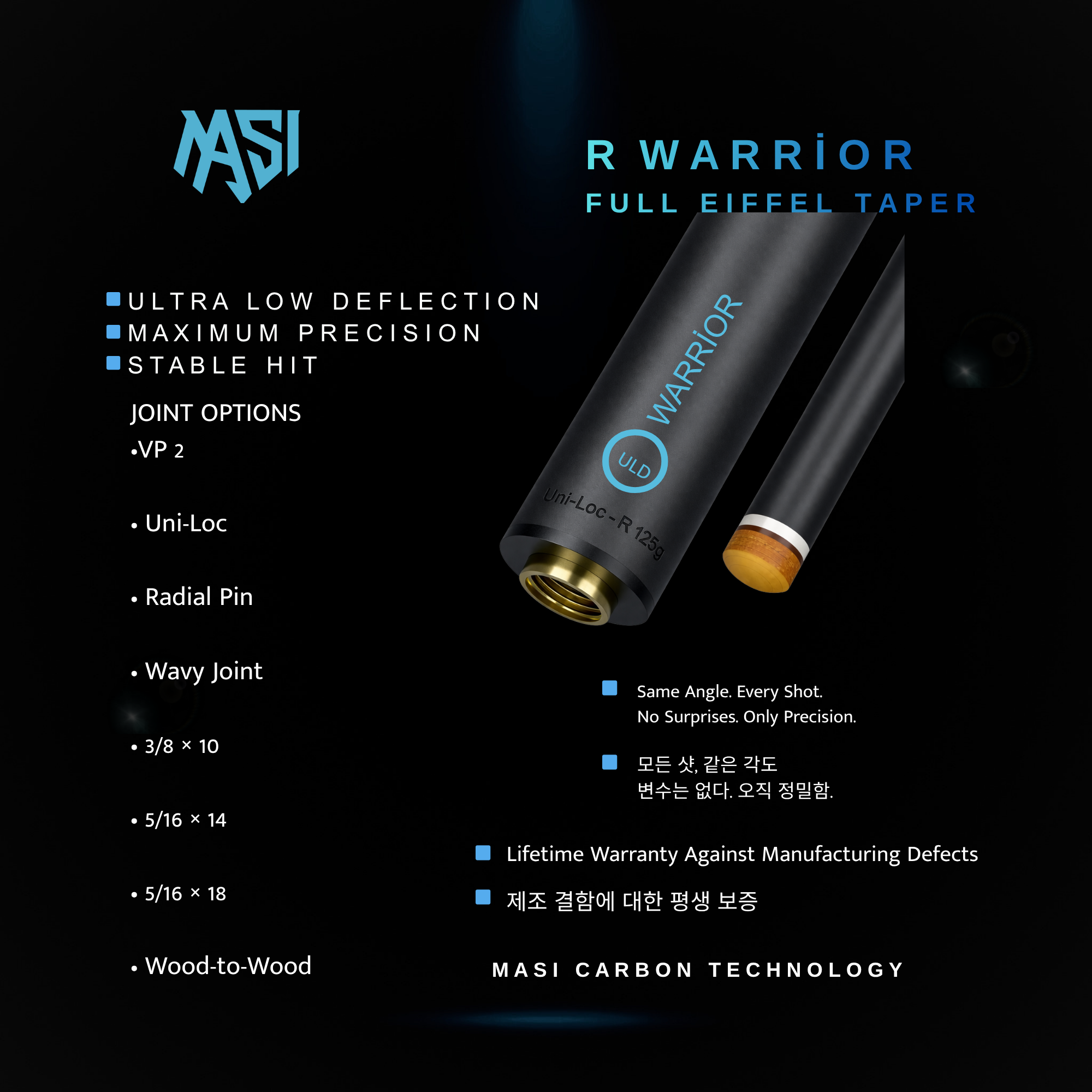
When players chase precision in billiards, they often use "squirt" and "deflection" interchangeably. Yet these are two distinct physical phenomena that determine how the cue ball behaves at the moment of contact. Understanding the difference is the key to understanding why carbon shafts have swept through professional billiards. At Masi Carbon, every shaft we engineer is built around one principle: minimizing the deviation between the line you aim and the line the ball travels.
What Is Squirt?
Squirt is the immediate sideways deflection of the cue ball when struck off-center, with English (side spin). The greater the mass at the tip end of the shaft, the more the cue ball is pushed off its intended path. Squirt is mechanical, instantaneous, and impossible to feel during the stroke — you only see it in the result.
How Does Deflection Differ?
Deflection is the broader, observable outcome. If squirt is the cause, deflection is the effect that you measure on the table. Experienced players develop "aim compensation" — an internalized correction baked into their visual line. While effective, this compensation is mentally exhausting and prone to error under pressure. Reducing squirt at the equipment level removes that cognitive load.
Why Tip-End Mass Matters
The dominant factor in squirt is the mass of the front 6-8 inches of the shaft, known as endmass. Traditional maple shafts are heavy in this zone because wood has fixed density. Carbon fiber, by contrast, can be engineered light and stiff at the same time. In our Warrior and Zafira series, Masi Carbon uses multi-layer woven composite specifically designed to lower endmass while preserving torsional rigidity. The result: the same stroke produces dramatically less cue ball deviation.
The Low-Deflection Design Philosophy
Modern low-deflection shafts follow a simple rule: reduce mass at the tip and dampen vibration along the shaft. Carbon fiber is the ideal material for this equation. In premium models like our Titan X, even the ferrule is reimagined — fiber-reinforced polymer replaces aluminum to avoid adding any unnecessary weight near the tip. Players describe the sensation as the cue ball "passing through" the line of aim rather than fighting it.
What You Actually Feel at the Table
The most common phrase from players who switch to carbon within the first week is: "I'm aiming less and making more." Side-spin shots become predictable. Position play gets cleaner because the cue ball ends where you imagined, not three inches off. Whether you play three-cushion carom, pool, or snooker, lower squirt frees the brain to focus on strategy instead of correction. Masi Carbon shafts have proven this in tournament play with Turkish and international competitors alike.
The Real Advantage of Carbon
Once you separate squirt from deflection in your mind, you see that carbon is not marketing — it is engineering. Reduced endmass, high rigidity, and controlled vibration combine to push deviation toward physical minimums. We can't eliminate squirt entirely; physics is non-negotiable. But cutting it by up to 50% is enough to redefine your relationship with the cue. With Masi Carbon, the only thing you'll second-guess is your strategy — never your shaft.