Professional Player Feedback — Notes From the Field
Masi Carbon shafts go through a long field-testing process before reaching the market. Here are the recurring themes that emerge from professional players' feedback.
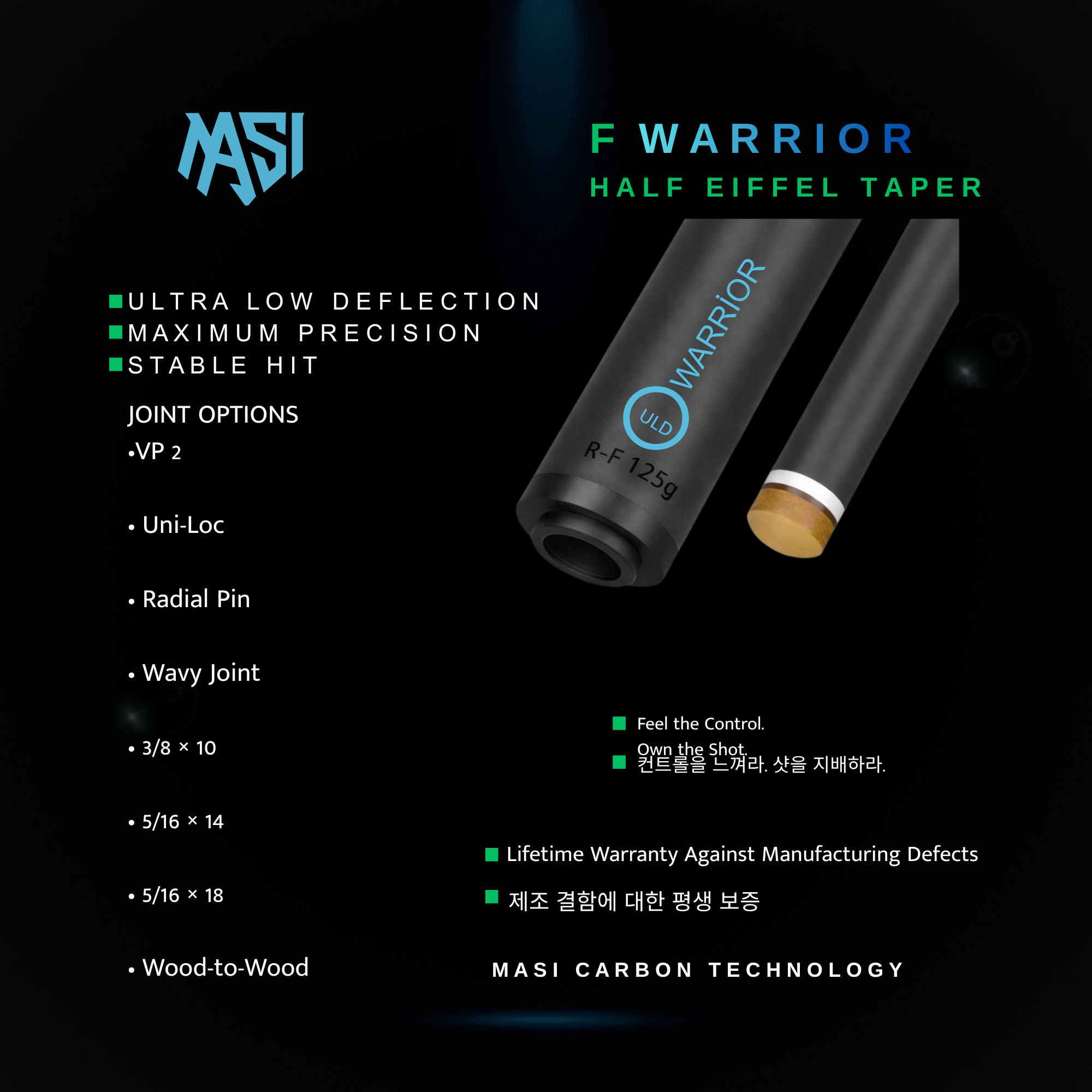
A carbon shaft is born in the lab, but it lives on the table. Masi Carbon's production line in Antalya runs every product through a long field-testing process before it reaches store shelves. Professional players use prototypes both in tournament conditions and in training sessions; the notes that come back become raw data on the R&D bench. In this article, without naming names, we share the recurring themes that surface from this field feedback.
Consistency: The Quiet Statement of a Shaft
The first and most frequently heard word from the field is consistency. Professionals want to play the same stroke twice and see the same result; a shaft that fails this expectation forces the user into constant micro-adjustments. The recurring theme in feedback received by the Masi Carbon team is that Warrior R, F and C shafts hold their feel throughout an entire session.
This is a natural consequence of carbon's reduced reactivity to temperature and humidity compared to wooden shafts. Notes such as "I didn't feel a difference between the morning and evening stroke" are decisive when prototypes graduate to production approval.
Low Deflection and Line Accuracy
The second recurring theme is low deflection. Professionals are highly sensitive to how far the cue ball drifts from the intended line, especially on long-distance, english-loaded shots. When carbon construction, a light tip mass and a correctly engineered taper come together, deflection drops to a minimum; the player stops thinking "how much do I correct" and starts thinking "how much english do I want to add".
The three taper philosophies of the Warrior series — Linear Eiffel, Hybrid Eiffel, Conical Power — tune this deflection behavior to the player type. Field notes confirm that the three characters do not blur into each other; each has its own signature line accuracy.
Hit Feel: The Data That Resists Numbers
The third theme is the most personal one: hit feel. What a professional calls "hit feel" is the resultant of dozens of variables, from vibration profile to damping behavior, from acoustic return to contact duration. That is why Masi Carbon, when collecting field data, attaches as much importance to player descriptions as to quantitative measurements.
Phrases like "soft but informative", "firm yet not tiring", "the sound coming back from the ball is clean" appear repeatedly in the field reports. These descriptions guide production decisions about carbon layer orientation, resin ratios and tip-ferrule selections. While different balance preferences are tested in cues such as Zafira and Titan X, the basic criterion remains: the feel must not fatigue the player over long sessions.
Pre-Launch Testing and the Feedback Loop
Masi Carbon's pre-launch testing is not a one-off validation; it is a continuous loop. Prototypes are sent to players of different levels, usage logs are collected, and the cue-shaft pairing balance is measured. Returning data is evaluated on the R&D bench under three main headings: structural behavior, in-use feel, and durability.
A prototype is approved for production only when it receives consistent positive feedback in all three categories. If the feedback is negative or unstable, the product is pulled from the line and revised. Our philosophy is plain: "good" is not enough — it must be worthy of the player. This loop ensures that new models like Black Mamba mature under the same discipline.
The Closed Loop Between R&D and the Field
Finally, it is worth underlining the closed-loop relationship between field notes and R&D. An engineer designs a shaft not only on a CAD screen but also alongside the player's stroke rhythm; the player, in turn, becomes more than a user of the current product — they become a stakeholder shaping the next one. This is part of Masi Carbon's identity as a brand designed, produced and tested in Türkiye.
Ultimately, professional feedback is not a marketing component but a real piece of the production process. The quiet notes from the field become a strong shaft on the table.