Massé Shot — Advantages With a Carbon Shaft
The massé is one of billiards' most demanding shots, pushing physics to its limits. The low deflection and high durability of carbon fiber shafts give players unmatched control when executing this extreme technique.
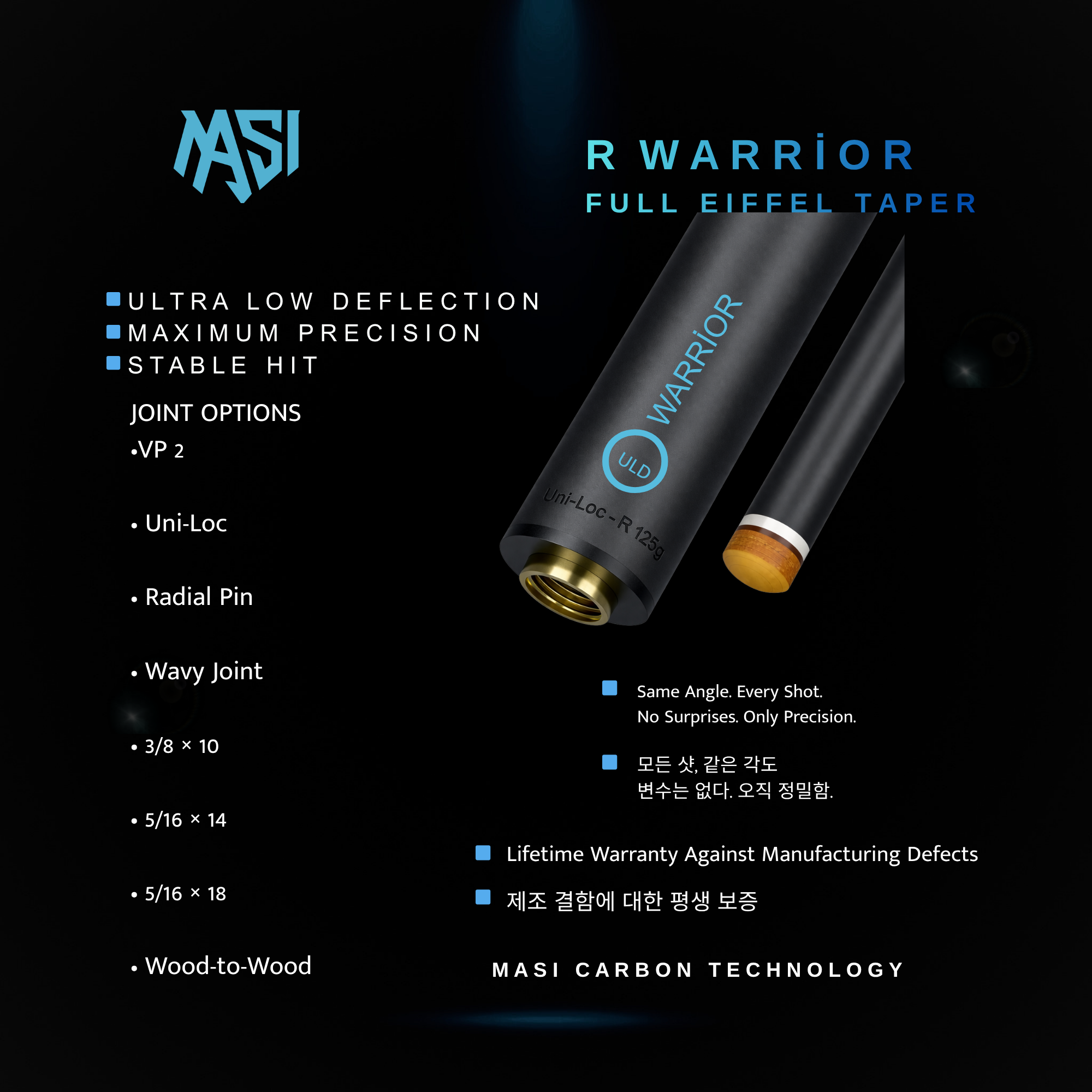
There is a moment at the billiard table when the spectator cannot believe their eyes: instead of traveling in a straight line, the cue ball draws a curved trajectory, escaping a blocking ball and reaching the target. This is the massé shot. Pushing the practical limits of physics, this technique demands extraordinary discipline from the player and extraordinary precision from the equipment. The Masi Carbon family produces carbon fiber shafts that give players confidence in extreme techniques like the massé.
The Physics of the Massé: Gravity and Angular Momentum
The massé is executed by striking the cue ball from above at a near-vertical angle, imparting heavy side and bottom spin. The cue ball begins spinning on its axis; as forward momentum decays, the friction force re-accelerates the spinning ball into a curved trajectory. The result is a ball drawing a parabola or reverse-J path on the cloth.
The last thing you want in this shot is a shaft that disrupts energy transfer to the ball. A low-deflection carbon shaft preserves the exact contact point the player intends, producing a predictable curve.
Elevated Cue and Shaft Durability
For a massé, the cue is raised at an angle between 45 and 90 degrees. This angle generates lateral loads and torsional stress on the shaft at the moment of impact. Wooden shafts can develop micro-cracks under repeated massé practice; the moisture-dependent structure of wood struggles to tolerate this stress.
Carbon fiber shafts, with their high tensile strength and uniform fiber distribution, absorb this stress effortlessly. Masi Carbon's R Warrior, F Warrior and C Warrior models are tested to withstand years of professional massé practice.
Low Deflection: The Real Difference in Massé
In a massé, the player strikes the cue ball at a point as far from center as possible. With ordinary shafts, this extreme contact point produces severe squirt and the ball departs in an unintended direction. The low end-mass of carbon fiber shafts minimizes this squirt.
In practice, this means the curve the player imagines is the curve that appears on the table. In tests with shafts like the Zafira or Titan X, the margin of error is reduced by more than half compared to wooden shafts. This is what it means to confidently call a massé in a tournament setting.
Tip Hardness and Friction Transfer
In a massé, the tip must grip the ball without sliding off the cloth. Tips that are too soft deform under vertical strikes and absorb part of the energy. Tips that are too hard slip and fail to deliver the intended spin. Medium-hard professional tips mounted on a carbon shaft provide balanced friction in vertical strikes.
Masi Carbon shafts come from the factory with tip hardness and ferrule structure optimized for these extreme techniques; players can begin massé practice immediately with out-of-the-box equipment.
Training Approach: Learning the Massé Safely
The massé is not a natural shot for any player. The safe path is to begin with short curve shots (semi-massé), then gradually elevate the cue to increase the angle. Using an impact pad beneath the cloth to prevent damage and learning the correct stroke speed are the basics of massé training.
A carbon fiber shaft offers margin for error during this learning process. The shaft's feedback is consistent; the same contact point produces the same result every time. This consistency is the fastest way to encode a complex technique like the massé into muscle memory. Masi Carbon embraces an equipment philosophy that lets players execute this frontier technique with elegance.