Masi Carbon Production Facility — Birth of a Carbon Shaft
How is a carbon fiber shaft born inside the Masi Carbon workshop in Antalya? We walk you through the production journey from raw prepreg to a polished Warrior shaft, step by step.
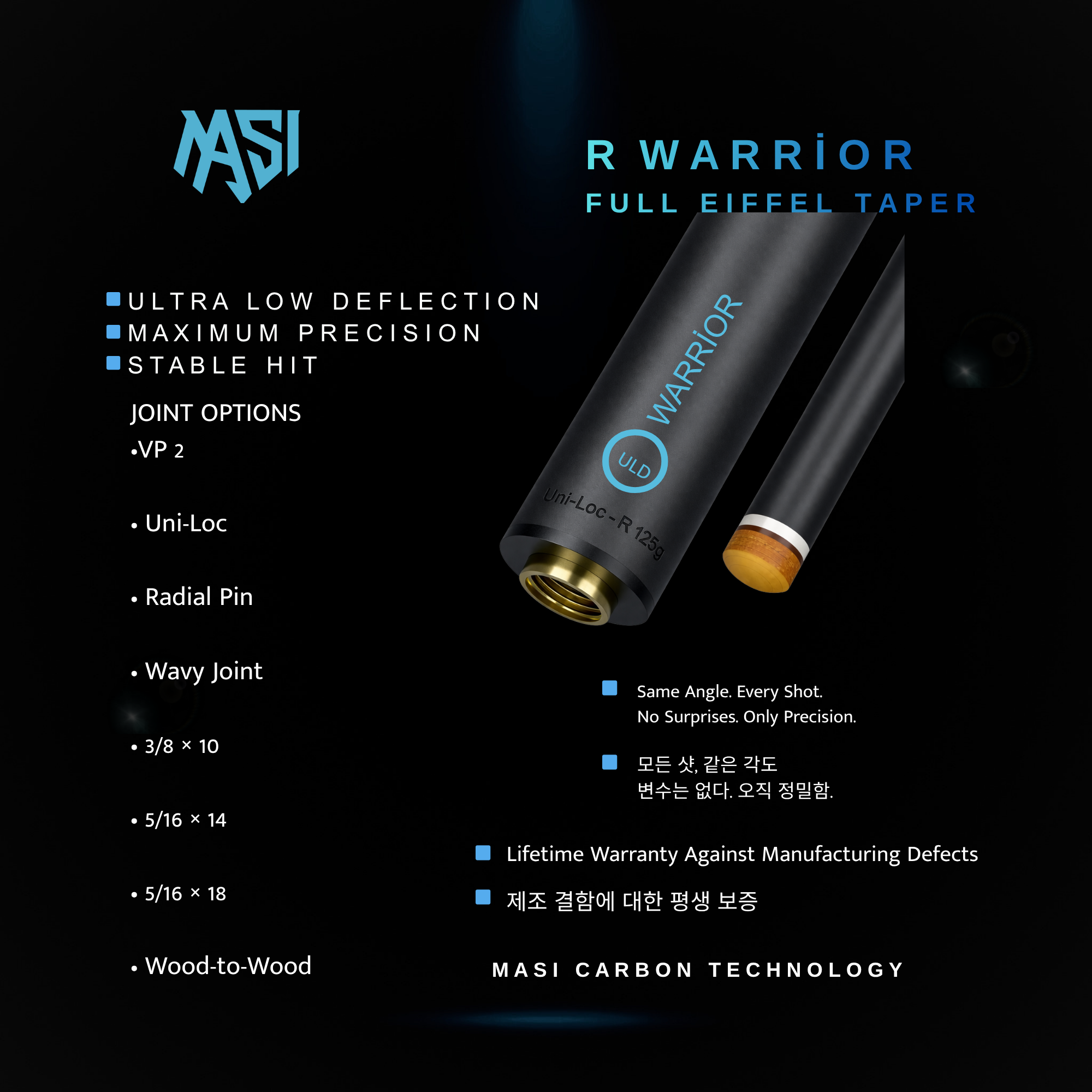
At first glance, a carbon fiber shaft looks like nothing more than a thin black tube. Inside the Masi Carbon production facility, however, every shaft passes through dozens of stages of skilled handwork, precise machine operations and rigorous quality checks. In our Antalya workshop, the Zafira, Titan X and Black Mamba models, alongside the R Warrior, F Warrior and C Warrior carbon shafts, are all built with the same level of care. In this article we will walk you through the journey, step by step, from raw carbon prepreg to a polished, finished cue shaft.
Raw Material: Selecting High Modulus Carbon Prepreg
It all begins with rolls of high modulus carbon fiber prepreg, kept in cold storage. Prepreg is carbon fabric that is already impregnated with resin, so it must be stored under controlled temperature and humidity to avoid premature curing. At Masi Carbon, since our founding in 2023, one of the most critical things we have refined is selecting this raw material with the correct fiber orientation, correct weight per square meter and correct resin content.
Following the recipes laid out by our founder, Irfan Yilmaz, each shaft model uses a different combination of layers. The full Eiffel, half Eiffel and conical geometries are each shaped with different fiber angles and a different number of plies. This is exactly what defines how a shaft feels at the moment of impact.
Cold Rolling and Mandrel Preparation
Once the prepreg is brought to the cutting table, it is sliced with millimetric precision according to a CAD drawing. The mandrel, the steel core that defines the inner diameter of the shaft, is then prepared both by hand and with machine assistance. During cold rolling, the prepreg layers are carefully wrapped around the mandrel. Wrap too quickly and you trap air bubbles; wrap too slowly and you risk premature curing. For this reason, at Masi Carbon, this step is only done by trained craftsmen.
During rolling, the order of fiber directions is preserved with great care: lower plies usually run close to the longitudinal axis, intermediate plies run diagonally for torsional rigidity, and the surface ply is laid at a specific angle for aesthetics and twist resistance. This architecture is what delivers minimum deflection and maximum feedback at the moment of contact.
Mandrel Cure — When Resin Meets Carbon
The wrapped shaft is then placed into the curing oven under heat and pressure. The resin melts during this stage, fills the gaps between layers and forms a full molecular bond with the carbon fiber. The temperature curve is raised slowly, held at a plateau for a defined duration and then brought down in a controlled way. This curve is one of the most critical parameters that shapes both the durability and the feel of the shaft.
Demolding, Grinding and Taper Shaping
Once cured, the shaft is removed from the mandrel. The inner surface is inspected and the raw outer diameter is measured. Then comes CNC grinding and taper shaping, where each model gets its signature taper profile. In the Warrior Carbon Shaft lineup, full Eiffel offers a clean, linear taper, half Eiffel uses a two-stage profile, while conical presents a more aggressive geometry for power players.
Surface Coating and Final Polishing
After the shaft reaches its final dimensions, multiple layers of UV resistant protective coating are applied. This coating protects against sweat and stabilizes the contact feel against the cloth. Polishing is then performed by hand inside a dust-controlled cabin. As a final step, the Masi Carbon logo is laser engraved, the joint and ferrule are mounted, and the shaft is sent to the testing department. Only then is a Masi Carbon shaft ready to leave the workshop door under our procedure.