Carbon Fiber Shaft Testing — Quality Control Steps
Which tests does a Masi Carbon shaft go through before it ever reaches the table? We break down every quality control step, from dimensional check to vibration analysis.
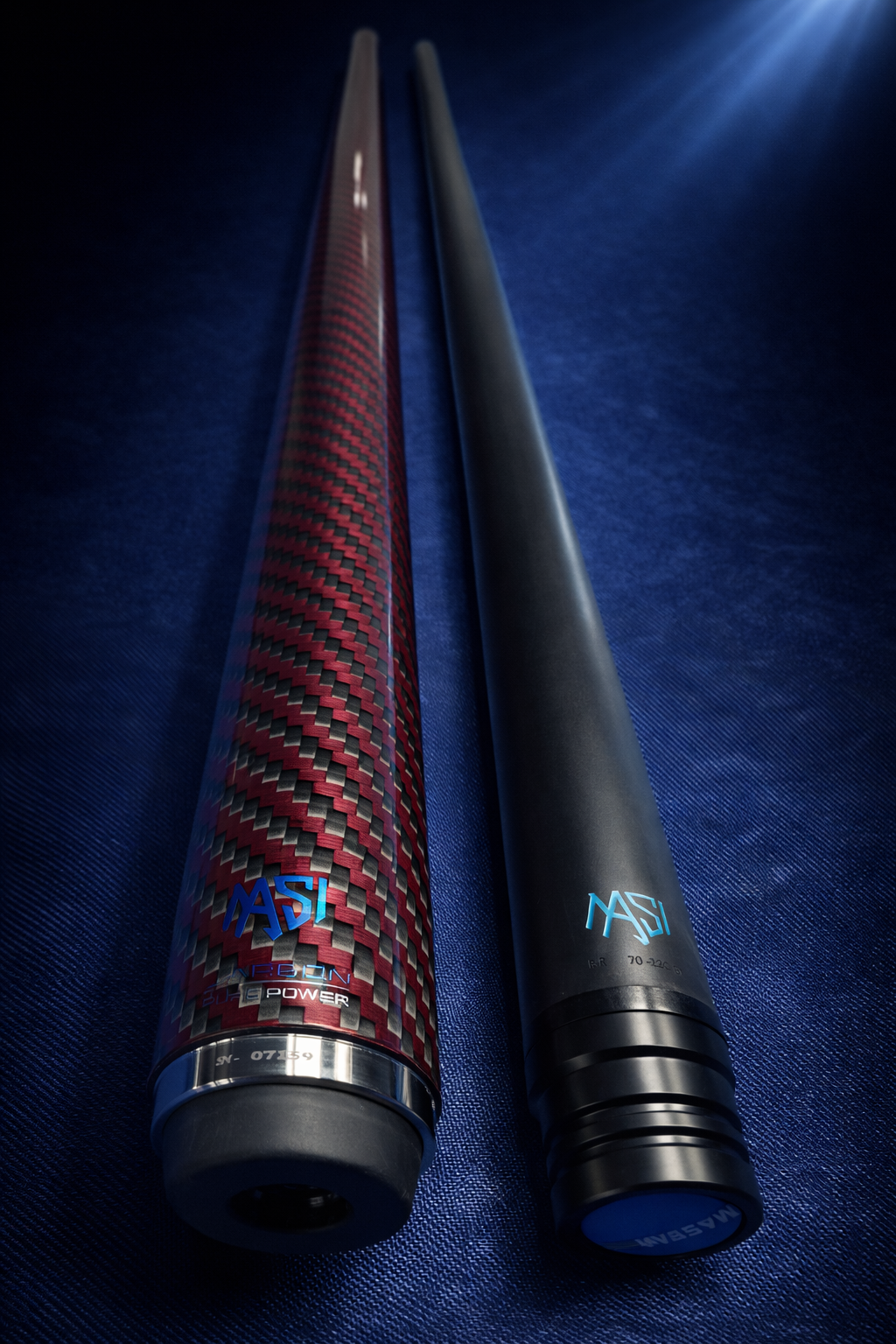
The real value of a carbon fiber shaft lies in the quality control discipline applied before it ever leaves the workshop. At Masi Carbon, every Zafira, Titan X, Black Mamba and Warrior Carbon Shaft model coming off our Antalya production line goes through a multi-stage test process before reaching the table. In this article we walk through every quality control step, from dimensional inspection to vibration analysis, because a great carbon shaft is not only well built — it is also well tested.
Dimensional Check — Discipline at Micron Level
The first stop is the dimensional control station. Shaft length, butt and tip diameters, taper profile and the joint mounting area are all measured with digital calipers and micrometers. Tolerances on carbon fiber shafts are tighter than on traditional wooden shafts, because the material does not expand thermally and behaves differently in elasticity. We use dedicated control templates for each of the Linear Eiffel, Hybrid Eiffel and Conical Power geometries.
Diameter is not measured at a single point but at multiple positions along the shaft. This way we verify both the linearity and the symmetry of the taper. Shafts that fail this stage are sent back for regrinding or rejected.
Weight and Balance Tolerance
At the next station, the shaft is placed on a precision scale. Masi Carbon defines a specific weight range for each model, and shafts outside that range are never shipped to a customer. Weight directly influences both the player's feel and the moment balance distribution. The shaft is then placed on a balance bar for a static balance check. An eccentric mass distribution causes deflection during the stroke, so the center of mass must fall inside our reference band.
Deflection Test
The most defining test for carbon fiber shafts is the low deflection test. The shaft is clamped at the joint side, a calibrated reference weight is hung at the tip, and the resulting deflection is read on a dial indicator. This tells us exactly how much unwanted side spin a shaft will impart to the cue ball during powerful strokes. In the Warrior Carbon Shaft lineup, each geometry has its own reference window; any shaft falling outside that window is rejected.
Vibration and Frequency Response
A shaft's "feel" might sound subjective, yet it is in fact measurable. We deliver a controlled impulse to the tip end of the shaft and analyze the resulting vibration spectrum. What we look for is the damping time and the dominant frequency band. A well engineered carbon shaft must rapidly damp out high frequency parasitic vibrations to give the player a clean feedback. This test is especially critical to verify that multi-stage geometries like Hybrid Eiffel really behave the way they were designed to.
Joint, Ferrule and Visual Inspection
The joint, which is the mechanical interface between the shaft and the player, goes through its own dedicated check. Thread angle, tightening torque and seating surface are compared against a quality template. Ferrule bonding is tested by applying a small torque, and any part that feels loose is removed from service. Finally, the shaft enters a visual inspection booth under specialized lighting where surface scratches, coating ripples, laser logo sharpness and color consistency are all examined one by one.
A shaft that passes every step is then labeled with a serial number and a test record before being sent to packaging. The Masi Carbon philosophy is clear: no carbon shaft that has not passed inspection ever reaches a player's hands. Because for us, quality control is not a line item on a cost sheet — it sits at the very center of our brand identity.