The Stroke in Billiards — Technique, Grip and Follow-Through
A great billiards stroke comes from balance, not force. Learn how pendulum mechanics, grip pressure, and follow-through transform your play — especially with the right carbon shaft.
In billiards, the stroke is the single most important factor that separates levels of play. No matter how expensive your cue is, an unbalanced stroke leaves the cue ball unpredictable. A great stroke is built on three pillars: the pendulum motion, correct grip pressure, and a complete follow-through. At Masi Carbon, we view the shaft not just as equipment but as the tool that lets these three pillars work in harmony.
The Pendulum Stroke
Modern billiards mechanics are built on the pendulum principle. The elbow stays fixed like a hinge while the forearm swings freely beneath it. Wrist, shoulder, and torso remain still through impact. This produces a repeatable motion — and in billiards, repeatability is everything. When the pendulum is set correctly, the cue tip travels in a single straight line through the center of the cue ball.
Grip Pressure: Holding Less Is Holding More
Beginners almost always grip the cue too tightly. Professionals describe the ideal grip as "holding a small bird" — not so loose it escapes, not so tight you hurt it. On a 1 to 10 scale, the right pressure sits between 1 and 3. A tight grip tenses the muscles, tense muscles vibrate the wrist, and that vibration translates directly into deflection. Carbon shafts shine here because their internal structure dampens vibration, allowing maximum control even with a feather-light grip.
Follow-Through
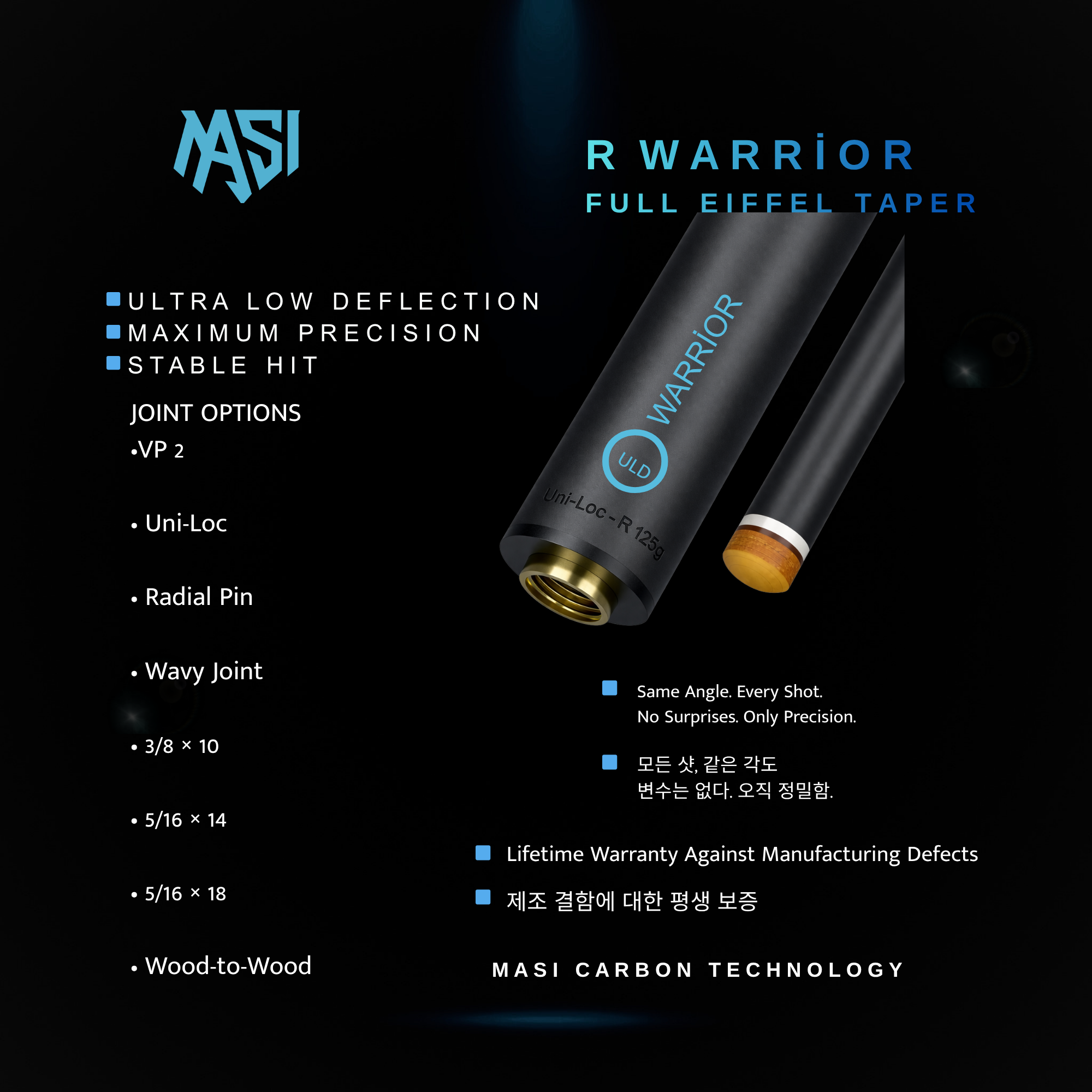
The stroke does not end at contact — the real stroke lives in the path the cue travels after contact. A complete follow-through means the tip continues forward at least 4-6 inches past the contact point. Players who cut their stroke short transfer vibration to the ball instead of energy. Full follow-through maximizes both power transfer and spin. The low-vibration profile of the Masi Carbon Warrior shaft makes that follow-through feel effortless and natural.
Common Mistakes and How to Fix Them
First mistake: head movement during the stroke. The chin should rest lightly on the cue and remain still. Second: the elbow drops or lifts during the swing. Once the pendulum breaks, the line breaks. Third: pushing instead of stroking. The arm should swing freely under its own weight, not muscle through the ball. Fourth: holding your breath. Proper rhythm exhales slowly during the final warm-up stroke before delivery.
How Grip Affects Cue Feel
The feedback a shaft transmits to the player depends heavily on grip style. A tight grip blocks feedback; a loose grip lets every contact detail reach the fingers. Carbon shafts are uniquely transparent in this regard — they deliver a cleaner, sharper vibration profile than wood. Players using the Masi Carbon Zafira series often say they can feel the cue ball's friction against the cloth in their wrist. Combined with correct grip pressure, that feedback gives you the answer to "what angle did the ball rebound from?" before your eyes even confirm it.
Training Recommendations
To improve your stroke, spend 15 minutes a day on the "straight shot drill": send the cue ball from one end of the table to the other with no English, and have it return along the exact same line. To audit your grip, play 10 shots holding the cue with only three fingers. These two exercises stabilize the pendulum and expose grip flaws fast.
Conclusion: Technique Meets the Right Tool
A perfect stroke takes years of repetition, but the right cue accelerates the journey. Once you internalize the pendulum, the soft grip, and the full follow-through, a carbon shaft like Masi Carbon multiplies your technique. It punishes nothing of your fundamentals and rewards everything you do right. In the end, billiards is the harmony of three things: eye, arm, and cue. Get all three on the same line — and you start winning.