Observation and Angle Calculation in Billiards
Learn how to build mental geometry on the table and read angles with confidence using ghost ball, contact point and fractional aiming methods.
Despite appearances, billiards is far more a game of observation and geometry than reflex. A professional scans the table at least three times before striking the cue ball: the angle to the object ball, the cue ball's path after contact, and the rebound lines off the rails. In this article we'll examine the three core methods of angle calculation — ghost ball, contact point and fractional aiming — and how to fold them into reliable mental mapping.
The Ghost Ball Method
The most intuitive method is the ghost ball technique. Draw an imaginary line from the centre of the pocket through the centre of the object ball; on the side of the object ball directly opposite that line, picture another ball touching it as if it were really there. That is exactly where the cue ball needs to end up at impact. A stroke that aligns the cue ball's centre with this ghost ball's centre will pocket the object ball. The only downside is that aiming at an invisible object can be confusing for beginners.
The Contact Point Method
The contact point method is more analytical. The point on the surface of the object ball that lies directly opposite the pocket along the ball-to-pocket line is the spot the cue ball must strike. The player builds a sight line connecting the cue ball with this point. The method is geometrically correct, but the human eye struggles to precisely locate a point on a curved surface. In practice, combining it with ghost ball delivers the most reliable results.
Fractional Aiming
Over time professional players group angles into fractions: full ball (1/1), 3/4 ball, half ball (1/2), 1/4 ball and a thin hit. Each fraction corresponds to a specific cut angle. A full ball is roughly 0 degrees, a half ball roughly 30 degrees, and a 1/4 ball roughly 48 degrees. The player estimates the angle on the table, maps their brain to the matching fraction-angle pair, and automates the stroke. After thousands of repetitions this becomes an internal sense.
Mental Geometry and Visualisation
What top-level players share is the ability to cinematically rehearse the entire scene in their mind before striking. The ball's trajectory, friction loss across the cloth, the rebound angle off the rail (usually 5 to 15 percent shallower than the incoming angle), and the cue ball's trail after contact are all 'seen' in advance. This visual capacity is trained, not innate. Visual systems developed by coaches like Stan Shuffett structure this mental mapping.
Common Angle Systems
In three-cushion carom, diamond systems (Plus 2, Reverse, Five System) push the player toward an arithmetic calculation using the diamond markings. On the pool side, the CTE (Center to Edge) Pro One system developed by Stan Shuffett leverages the eye's natural alignment ability. In snooker, geometry is less formulised; the Hendry or O'Sullivan approach is a blend of fractional aiming and instinctive visualisation.
How Shaft Selection Affects Angles
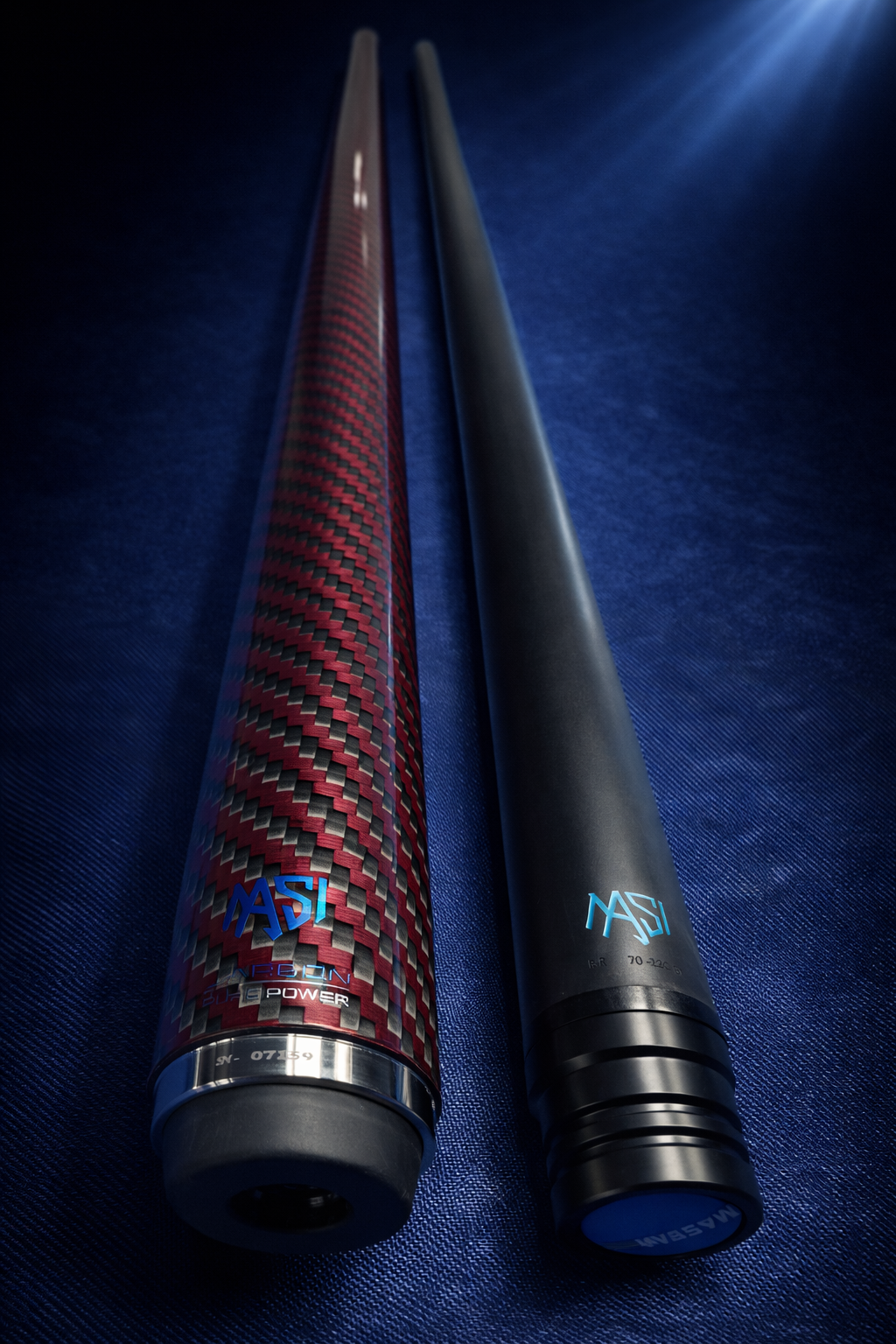
A well-calculated angle can still be ruined by a poor shaft. Wooden shafts with high deflection deviate the cue ball off your planned line whenever English is applied, forcing the player to unconsciously recalculate. Masi Carbon carbon fiber shafts, with their low deflection and high consistency, stay loyal to your geometric calculation. In other words, once you learn your angle system, your equipment doesn't sabotage it.
Practical Drills
The most effective way to train angles is repetition with simple tape or paper markers on the table. Try a half-ball cut from twenty different positions, then move to 1/4 ball. On every shot, cycle your eyes between ghost ball, contact point and fractional reference. Within three to four weeks your brain begins to read angles as feel rather than numbers. That, ultimately, is the foundation of professional play: internalising the math until it becomes instinct.