Billiard Ball Strike Mechanics — Cue Ball Path Analysis
The path a cue ball follows after impact is no accident; contact angle, friction and spin combine to dictate its trajectory. This article explores the full mechanics, from physics formulas to the advantages of a Masi Carbon shaft.
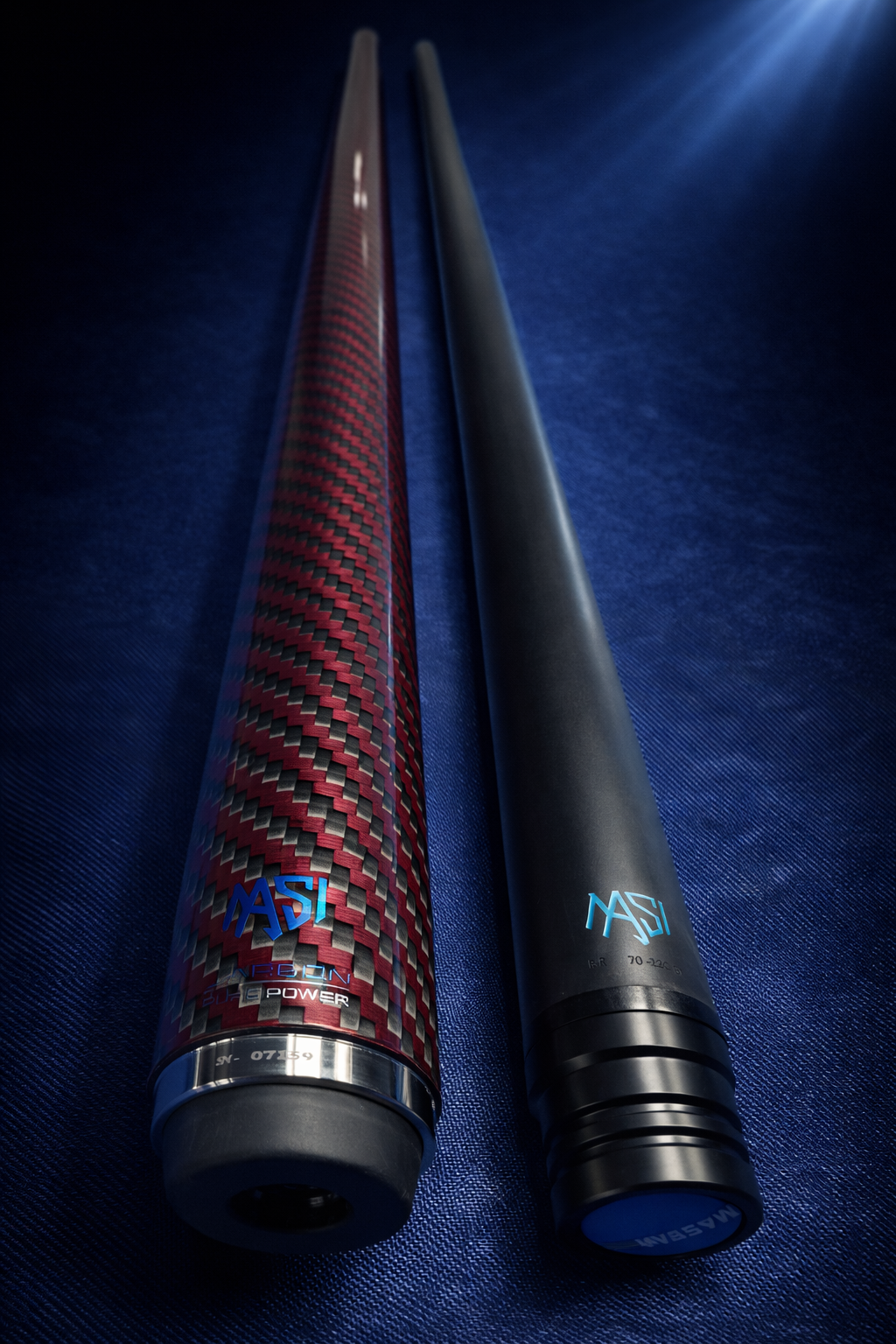
Every successful position play in billiards begins with anticipating where the cue ball will travel. The path the ball follows after impact is the combined result of contact point, stroke speed, spin and table friction. Professional players calculate these physical interactions intuitively in a fraction of a second. At Masi Carbon, understanding the science behind the shafts that deliver this precision is fundamental to our craft.
The Tangent Line and the 90-Degree Rule
When two balls collide in a stun shot, the cue ball travels along the tangent line — the line perpendicular to the centers of both balls at the moment of contact. This is the classical 90-degree rule: in a spinless collision, the cue ball moves exactly perpendicular to the object ball's path. This is the mathematical foundation of position planning.
However, pure stun shots are rare in real play. Top, bottom or side spin applied to the cue ball bends the 90-degree line. The degree of deviation depends directly on the deflection value of the shaft used during the stroke.
The Effect of Follow and Draw on the Path
When follow (top spin) is applied to the cue ball, the ball retains its forward momentum after striking the object ball and falls in front of the tangent line. Draw (bottom spin) pulls the cue ball behind the tangent. These path alterations grow exponentially with stroke power and tip-offset distance.
Low-deflection carbon shafts such as the R Warrior and F Warrior deliver pure spin transfer to the ball; the energy loss seen in wooden shafts is minimized. This means the calculated path is reproduced on the table exactly as planned.
Side Spin and the Squirt Phenomenon
When side spin (English) is applied, the cue ball squirts slightly in the opposite direction at the moment of tip contact. The magnitude of squirt is directly proportional to the shaft's end-mass. Carbon fiber shafts have a far lower end-mass than wooden shafts, dramatically reducing squirt.
The practical result is a smaller gap between the player's aim line and the cue ball's actual departure line — a more predictable path and a higher pocketing percentage.
Table Friction and the Role of the Cloth
Once the ball is in motion, the cloth's friction coefficient determines the transition from sliding to rolling. On new, fast cloth this transition happens later, so draw and follow effects persist over longer distances. On worn cloth, the ball enters the rolling phase quickly and spin influence on the path diminishes.
Professional players factor this variable into their practice. A high-precision shaft maintains stroke quality regardless of cloth condition, allowing the player to focus solely on environmental variables.
Post-Collision Angle Calculation: A Practical Approach
On a half-ball hit, the angle between the cue ball and object ball is approximately 30 degrees. On a quarter-ball hit, the angle approaches 49 degrees; on thin cuts, it exceeds 70 degrees. Internalizing these angles allows a player to plan three or four shots ahead.
Masi Carbon shafts such as the Zafira and Titan X are tools that faithfully translate the geometric map in the player's mind onto the table. Strike mechanics is a science; the right equipment turns that science into art.