Billiard Physics: Angles, Spin and Force
Physics principles on the billiard table: angle calculation, topspin, backspin, masse shots, and force-velocity relationship. Masi Carbon's role in spin transfer.
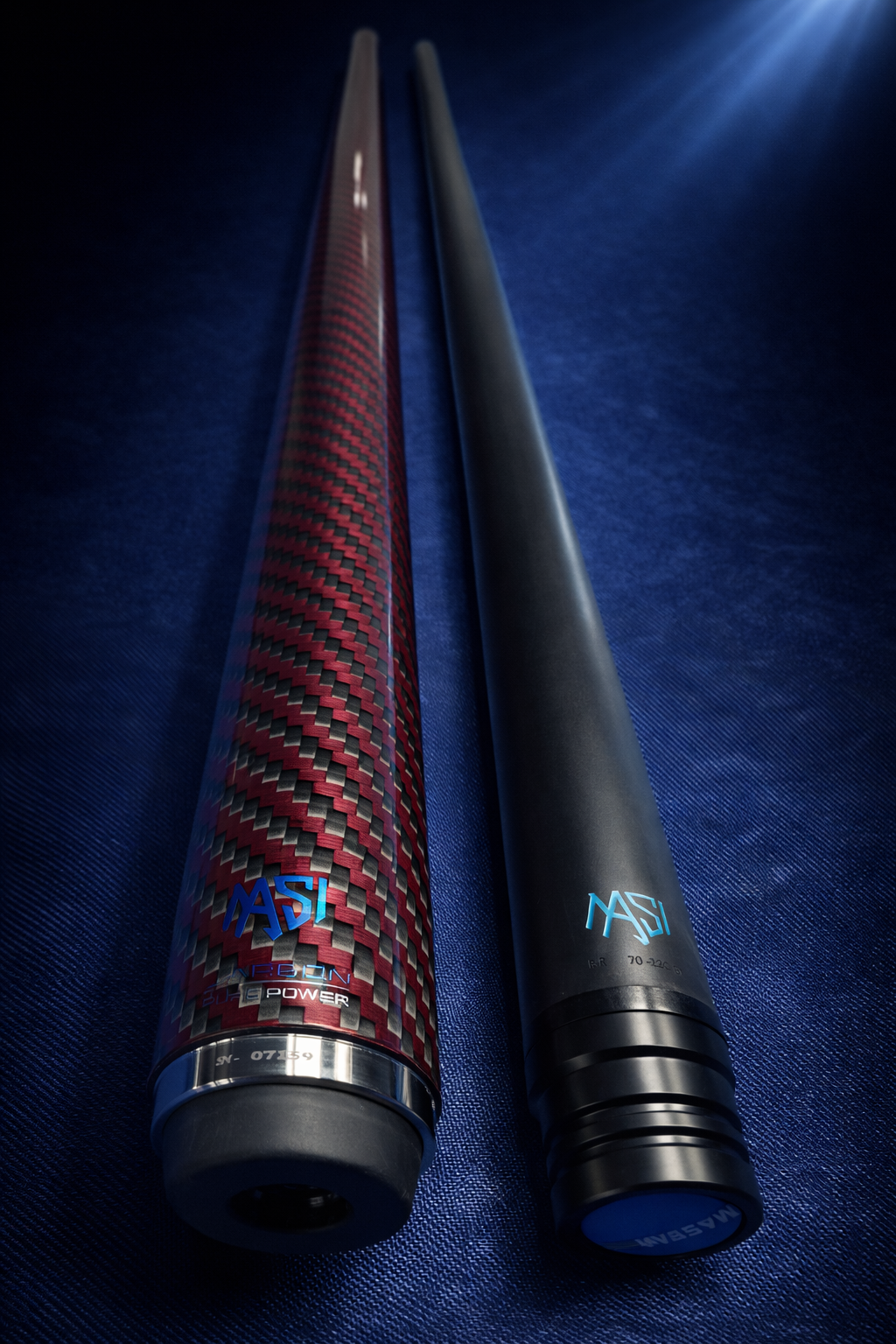
Billiards: Where Science Meets Art
Billiards is a far more complex physics laboratory than it appears. Every shot involves angles, momentum, friction, and elastic collision rules. In this article, we examine the fundamental physics principles that will improve your table performance and how Masi Carbon cues optimize these principles.
Angle Calculation and Reflection Rules
The rule "angle in, angle out" is the foundation of billiards. The ball's entry and exit angles at the cushion contact point are equal—under ideal conditions. In practice, friction, ball spin, and cushion material slightly alter this rule. Players who practice angles systematically learn these deviations through experience. Masi Carbon's consistent strike characteristic provides predictability in angle calculations.
Topspin and Backspin (Follow and Draw)
Topspin (follow) occurs when striking the top of the ball; the ball rolls forward and gains extra distance in its direction of travel. Backspin (draw) is achieved by striking the bottom, causing the ball to come back. Both techniques depend on the cue's efficient energy transfer to the ball. Carbon fiber cues, especially Masi Carbon models, maximize spin transfer through low vibration loss—more effect with less power.
Masse Shot and Side Spin (English)
The masse shot is a dramatic technique where the cue is held nearly vertical, striking the ball from the side. The ball curves across the table. Side spin (english) is used by striking the sides of the ball to change cushion angles. Both techniques require precise control. The balanced structure and consistent flex of Masi Carbon cues give players confidence in these difficult shots.
Force-Velocity Relationship
The relationship between cue speed and ball speed is not linear. Energy transfer depends on the cue's mass, stiffness, and strike point. Carbon fiber's high stiffness-to-weight ratio enables more efficient energy transfer. In practice, this means precise control even on soft shots at short distances. Masi Carbon's engineering team makes meticulous calculations for optimal energy transfer in each model.
Applying Physics Knowledge in Practice
Theoretical knowledge is worthless unless translated into practice. The recommended approach: Learn one concept, repeat it thousands of times at the table, then move to the next. Masi Carbon cues accelerate this learning process through their consistent performance—you get the same response with every shot, making it easier to identify and correct your errors.